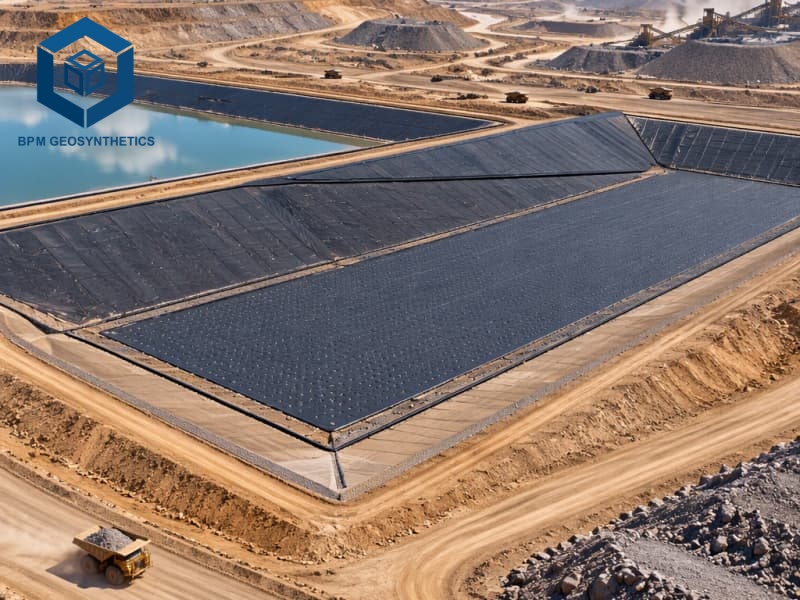
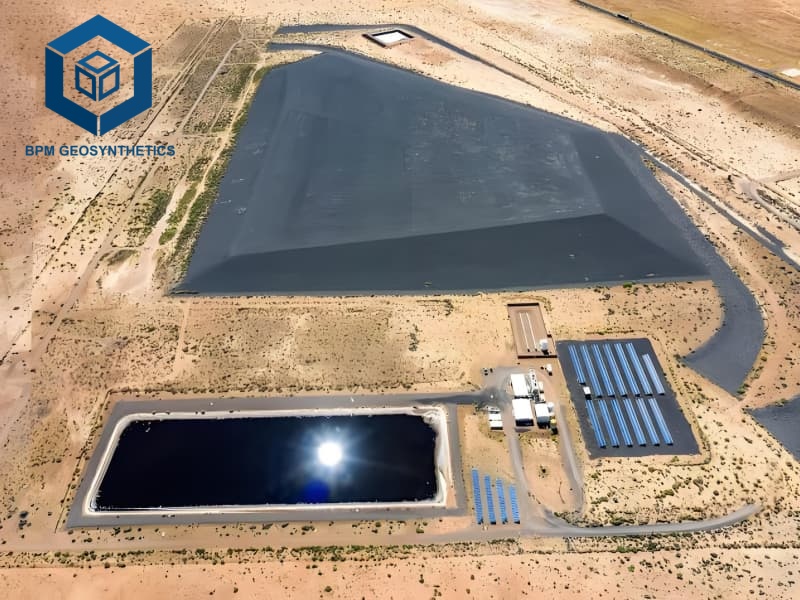
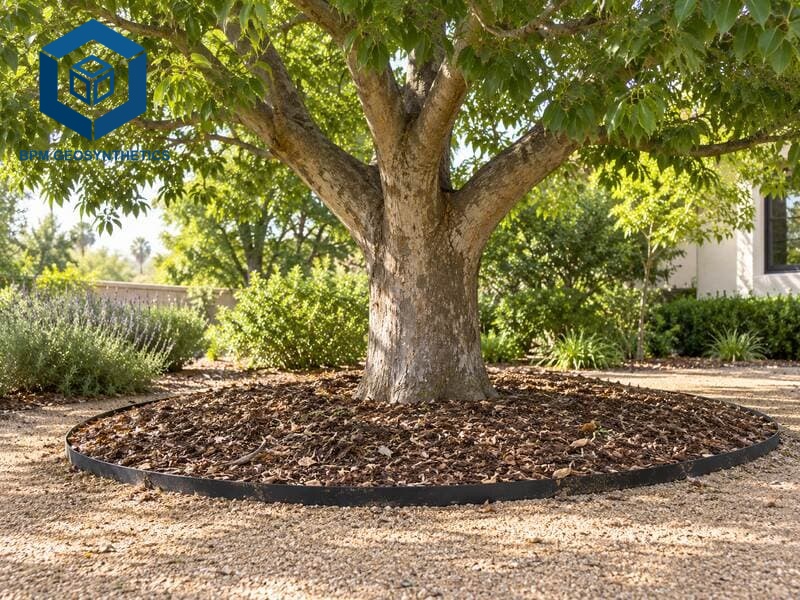
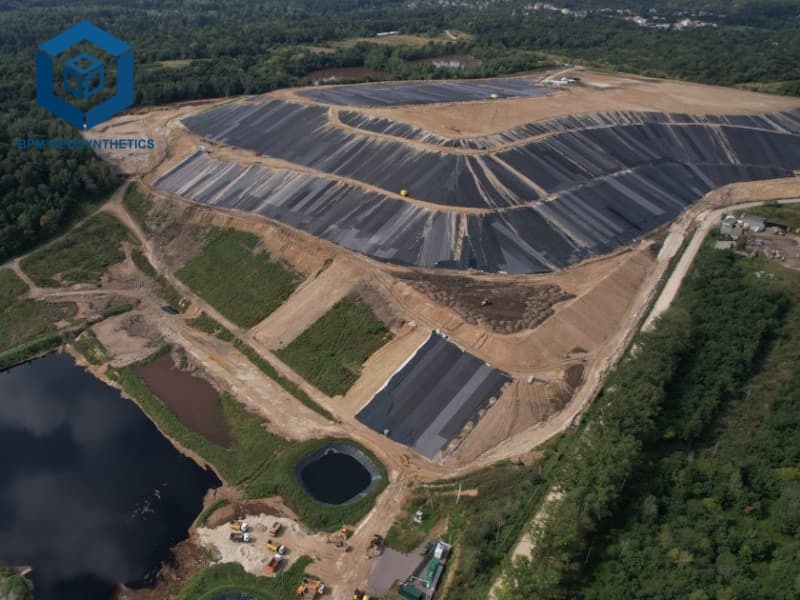
Geomembrane waterproofing systems are impermeable synthetic barriers used to prevent water, fluid, or contaminant migration in civil, environmental, and industrial projects. These systems protect foundations, tunnels, roofs, landfills, reservoirs, canals, and secondary containment structures from seepage, hydrostatic pressure, and chemical attack. In 2026, high-quality geomembranes—primarily HDPE Geo membrane, LLDPE, and flexible PVC—remain essential for reliable, long-term waterproofing where traditional materials such as concrete or compacted clay are insufficient or impractical.
Quantifiable performance metrics define effective geomembrane waterproofing. For HDPE meeting GRI-GM13, minimum average roll values for 60 mil (1.5 mm) smooth material include density ≥0.940 g/cm³, tensile yield strength of approximately 22 kN/m, break elongation ≥700 percent, puncture resistance of 480 N, standard OIT ≥100 minutes, and high-pressure OIT ≥400 minutes. Flexible PVC (ASTM D7176) typically offers elongation of 250–450 percent and competitive cost for lighter-duty or complex geometries. Hydraulic conductivity is typically ≤1 × 10⁻¹¹ cm/s for premium polyethylene. When properly installed, seepage reduction of 95–99.9 percent is routinely achieved. Service lives of 20–50+ years under soil cover or protected conditions are common. Material costs generally range from $0.60 to $5.00 per square meter depending on polymer, thickness, and surface finish.
This review ranks the eight best geomembrane waterproofing solutions based on standards compliance (GRI-GM13 or ASTM D7176), mechanical properties, chemical resistance, UV stability, installation practicality, and documented field performance in waterproofing applications. Selection criteria emphasize impermeability, puncture resistance, flexibility where needed, and long-term reliability. Among the leading options, the PVC Geomembrane Liner from The Project Material Co., Ltd. (BPM Geosynthetics) provides flexible performance characteristics suitable for certain waterproofing applications. Detailed product information is available at https://www.bpmgeosynthetics.com/product/pvc-geomembrane-liner/.
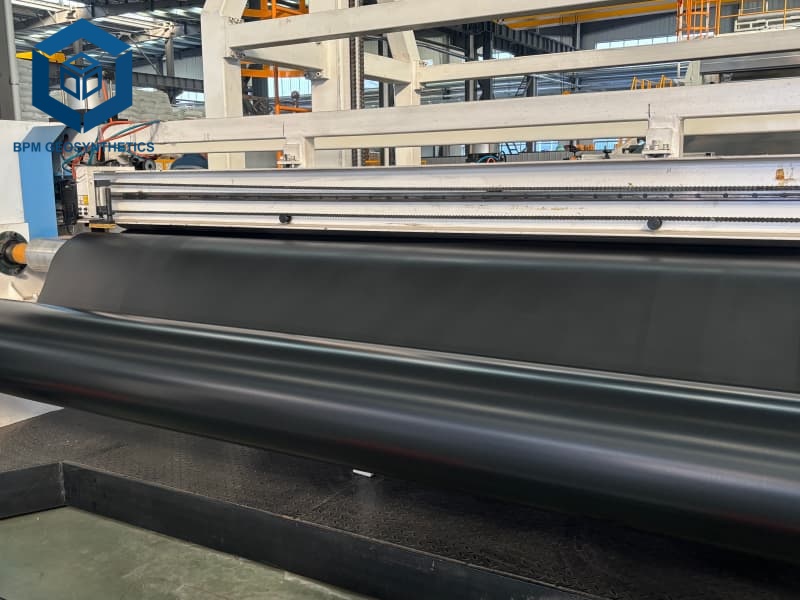

1. Why Geomembrane Waterproofing Delivers Superior Protection
Traditional waterproofing methods such as concrete, bituminous coatings, or compacted clay often suffer from cracking, settlement sensitivity, or limited chemical resistance. High-quality geomembrane waterproofing reverses these limitations with measurable advantages:
- Near-zero permeability (≤1 × 10⁻¹¹ cm/s) that isolates structures from water and contaminants.
- High elongation that accommodates settlement and structural movement without cracking.
- Excellent chemical resistance to a wide range of fluids when the correct polymer is selected.
- Rapid installation and verifiable seam integrity through thermal welding or adhesive methods.
- Multi-decade service life under protective cover, reducing lifecycle maintenance costs.
These attributes make geomembrane liner the preferred waterproofing solution for critical infrastructure, environmental protection, and water-containment projects worldwide.
2. Essential Selection Criteria for Geomembrane Waterproofing
Engineers and project owners should evaluate the following quantifiable parameters:
- Polymer Type: HDPE for high tensile strength, chemical resistance, and longevity; LLDPE for greater flexibility on irregular surfaces; PVC for complex geometries and lighter-duty applications.
- Thickness: 0.5–1.0 mm for light waterproofing and decorative applications; 1.5 mm (60 mil) as the industry standard for most critical projects; 2.0 mm or greater for high-load or aggressive environments.
- Mechanical Properties: Tensile strength, elongation, tear resistance, and puncture resistance appropriate to the expected stresses.
- Durability Metrics: UV stability (carbon-black content 2–3 percent for HDPE), low-temperature flexibility, chemical resistance, and oxidative induction time.
- Installation Factors: Roll widths, seaming method (thermal welding for HDPE/LLDPE; adhesive or thermal for PVC), and compatibility with protective geotextiles.
- Standards Compliance: GRI-GM13 for HDPE, GRI-GM17 for LLDPE, or ASTM D7176 for PVC, plus project-specific requirements.
Matching these data points to hydrostatic pressure, chemical exposure, structural movement, and expected service life ensures optimal waterproofing performance.
3. The 8 Best Geomembrane Waterproofing Solutions for 2026
The following rankings synthesize technical specifications, independent testing references, and documented performance in waterproofing applications. Rankings prioritize materials with proven field track records from established non-Chinese sources.
3.1 Solmax GSE HD HDPE Geomembrane
Solmax GSE HD is a high-density polyethylene liner widely specified for landfill waterproofing, mining containment, and large reservoir projects. It meets or exceeds GRI-GM13 and is available in smooth and textured finishes. Typical 1.5 mm values include tensile yield of 22 kN/m or higher, puncture resistance of 480 N or more, and high-pressure OIT ≥400 minutes.
3.2 Agru America HDPE SmoothLiner / MicroSpike
Agru’s precision-extruded HDPE delivers excellent thickness uniformity and elevated interface friction in textured form. Mechanical properties align with or surpass GRI-GM13 minima, supporting both base and slope waterproofing applications.
3.3 Layfield HDPE / Enviro Liner Series
Layfield products emphasize conformability and specialized stabilizer packages. Certain grades offer elevated high-pressure OIT retention. Suitable for moderate-scale waterproofing on irregular subgrades and secondary containment.
3.4 Atarfil HDPE Geomembrane
Atarfil produces HDPE liners with wide rolls that minimize seams and strong UV performance. GRI-GM13 compliance and reliable mechanical values make it appropriate for both covered and partially exposed waterproofing installations.
3.5 Raven Multi-Purpose / Industrial HDPE
Raven formulations provide solid chemical resistance, reliable weldability, and competitive mid-range pricing for thicknesses commonly used in industrial waterproofing and secondary containment projects.
3.6 Specialty Conductive or Enhanced HDPE Grades
Specialty grades incorporating conductive layers enable electrical leak-location surveys. Enhanced antioxidant packages address more aggressive chemical environments while retaining full GRI-GM13 compliance.
3.7 Flexible LLDPE Geomembrane Options
LLDPE formulations meeting GRI-GM17 offer higher multi-axial elongation and superior conformability for irregular surfaces, tunnels, and complex waterproofing geometries while maintaining excellent impermeability.
3.8 Flexible PVC Geomembrane Options (ASTM D7176)
Flexible PVC formulations offer higher elongation (250–450 percent) and excellent conformability for complex waterproofing details, lighter-duty applications, and projects where flexibility is prioritized over maximum tensile strength.
4. Comparison Table: Core Technical Parameters of Leading Geomembrane Waterproofing Materials
| Rank | Product / Brand | Polymer | Thickness Range (mm) | Tensile Yield / Break | Puncture Resistance (N) | Key Strength | Approx. Price Range ($/m²) |
| 1 | Solmax GSE HD | HDPE | 0.75–3.0 | 15–37 kN/m | 265–800+ | Scale & reliability | 1.20–4.50 |
| 2 | Agru SmoothLiner / MicroSpike | HDPE | 0.75–3.0 | 11–38 kN/m | 267–845 | Uniformity & friction | 1.40–4.80 |
| 3 | Layfield HDPE / Enviro | HDPE | 0.75–2.5 | 15–29 kN/m | 236–500+ | Conformability | 0.90–3.50 |
| 4 | Atarfil HDPE | HDPE | 0.75–3.0 | 15–45 kN/m | 300–850 | Wide rolls & UV | 1.30–4.00 |
| 5 | Raven Multi-Purpose | HDPE | 0.75–2.5 | 15–35 kN/m | 300–700 | Chemical resistance | 1.00–3.20 |
| 6 | Specialty / Conductive HDPE | HDPE | 1.0–3.0 | 22–45 kN/m | 480–960+ | Leak detection capability | 1.80–5.00 |
| 7 | Flexible LLDPE | LLDPE | 0.75–2.0 | High multi-axial | 200–600 | Superior conformability | 0.90–3.50 |
| 8 | Flexible PVC (ASTM D7176) | PVC | 0.5–1.5 | 12–22 MPa | 200–450 | High elongation & flexibility | 0.60–2.50 |
Data compiled from GRI-GM13, ASTM D7176, and manufacturer technical references. Values are thickness-dependent.
5. Manufacturer Comparison: Market Position, Clients, and Certifications
| Manufacturer | Est. Revenue Share (Geomembrane Segment) | Major Clients / Sectors | Key Certifications | Notable Strengths |
| Solmax (including GSE) | 12–20% | Landfills, mining, large waterproofing projects | GRI-GM13, ISO 9001, NTPEP, CE | Production scale, project experience |
| Agru America | 8–12% | Municipal, industrial, slope waterproofing | GRI-GM13, ISO 9001, NSF-61 | Precision extrusion, textured friction |
| Layfield | 4–8% | North American waterproofing & containment | ASTM, ISO, NSF options | Flexibility, specialized grades |
| Atarfil | 5–8% | Exposed or partially exposed waterproofing | GRI-GM13, CE, ISO 9001 | Wide rolls, UV focus |
| Raven (Solmax group) | Niche | Industrial process & secondary waterproofing | GRI-GM13 aligned | Versatile industrial grades |
| BPM Geosynthetics (The Project Material Co., Ltd.) | Growing specialized share | Global decorative, aquaculture, irrigation, and flexible waterproofing projects | ISO 9001, CE, ASTM D7176 equivalents | Flexible PVC performance, competitive value, customization |
Revenue-share estimates are approximate and derived from industry visibility; actual figures vary by region and year.
6. BPM Geosynthetics Advantages: PVC Geomembrane Liner by The Project Material Co., Ltd. (BPM Geosynthetics)
While HDPE dominates high-load and long-life waterproofing applications, many projects benefit from flexible alternatives. The PVC Geomembrane Liner from The Project Material Co., Ltd. (BPM Geosynthetics) offers a practical option for complex geometries, lighter-duty waterproofing, and moderate-head applications where high elongation and ease of installation are prioritized. Produced with flexible PVC formulations meeting or exceeding key ASTM D7176 index properties, the product supports reliable impermeability and conformability.
Quantifiable advantages include:
- Thickness options commonly ranging from 0.5 mm to 1.5 mm (20–60 mil), covering light to moderate-duty waterproofing applications.
- Tensile strength, elongation (typically 250–420 percent), and tear resistance consistent with ASTM D7176 expectations for the selected thickness.
- Good plasticizer retention and dimensional stability supporting multi-year flexibility under soil cover or protected conditions.
- Competitive pricing and customization capabilities practical for both small and medium-scale projects.
- ISO-certified manufacturing systems that support quality consistency across production runs.
- Availability of factory-fabricated panels or wide rolls that reduce field seaming requirements.
These attributes enable project teams to achieve effective waterproofing and conformability in appropriate applications while managing material and installation costs. When combined with proper subgrade preparation, quality seaming, and protective cover where required, the BPM PVC Geomembrane Liner contributes to reliable performance as a flexible geomembrane waterproofing option.
Detailed product information is available at https://www.bpmgeosynthetics.com/product/pvc-geomembrane-liner/.
7. Design, Installation, and Lifecycle Considerations for Geomembrane Waterproofing
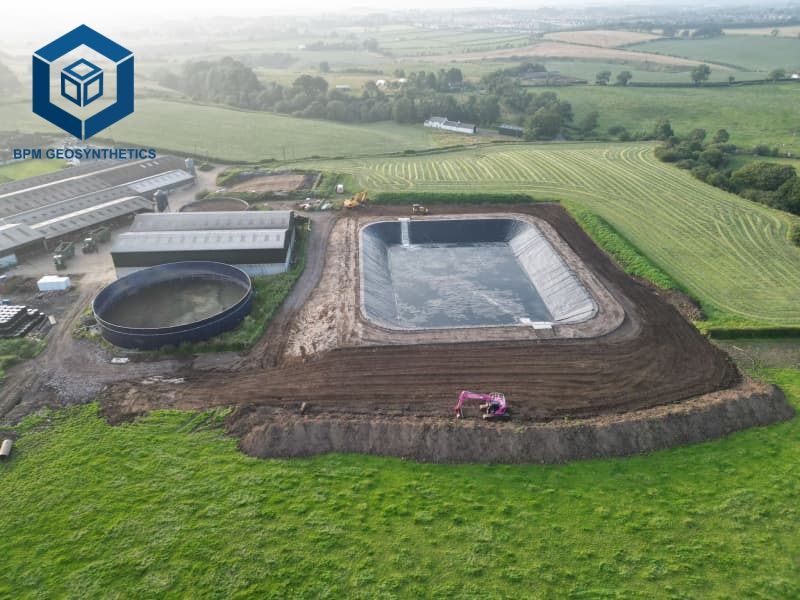
Successful geomembrane waterproofing requires thorough subgrade preparation to eliminate sharp objects and achieve adequate smoothness. Field seams must be constructed by qualified technicians using calibrated equipment and verified by appropriate testing. Protective geotextiles and soil covers enhance puncture resistance and longevity. When these practices are followed, measured seepage rates remain negligible and a quality geomembrane waterproofing system routinely achieves service lives of 20–50+ years under cover.

Conclusion
The eight geomembrane waterproofing solutions reviewed provide quantifiable, standards-compliant performance for the full spectrum of waterproofing applications, from light decorative features to high-load landfills and industrial containment. HDPE meeting GRI-GM13 remains the dominant choice for critical, long-life projects due to superior tensile strength, puncture resistance, and chemical inertness. Flexible PVC and LLDPE variants address sites with significant settlement or complex geometry.
For projects seeking flexible material quality and competitive value, the PVC Geomembrane Liner from The Project Material Co., Ltd. (BPM Geosynthetics) offers a practical and data-supported option. Specifiers should request current technical data sheets, third-party test reports, and project references. Selecting geomembrane waterproofing on the basis of measured performance metrics ensures regulatory compliance, long-term protection, and favorable lifecycle economics.