Description
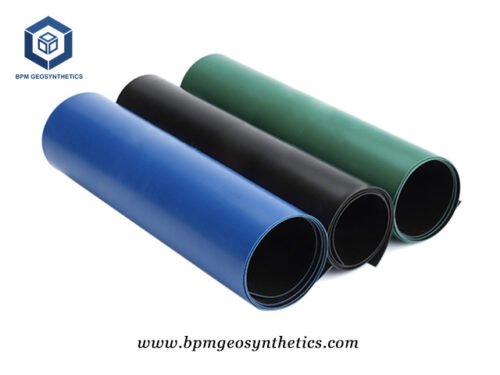
PVC geomembrane liner remains one of the most versatile and widely specified flexible barrier materials in environmental containment, water management, and civil engineering projects. Manufactured by BPM Geosynthetics from polyvinyl chloride compounded with carefully selected plasticizers, stabilizers, and performance additives, these liners deliver exceptional conformability, ease of installation, and reliable impermeability for a broad range of moderate-risk applications.
This BPM product description provides engineers, contractors, project owners, and procurement professionals with detailed technical insights into PVC geomembrane liners. It covers material composition, key specifications aligned with ASTM D7176, primary performance properties, thickness selection guidance (mm, mils, and microns), expected service life, common applications, and practical considerations for successful project outcomes.
What Is A PVC Geomembrane Liner
A PVC geomembrane liner is a flexible, thermoplastic impermeable sheet manufactured primarily from polyvinyl chloride resin combined with plasticizers (typically 25–35% by weight), heat stabilizers, UV stabilizers, biocides, and other additives. Unlike rigid PVC used in pipes or profiles, geomembrane-grade PVC is formulated for high flexibility and elongation so that it can conform tightly to irregular subgrades, accommodate differential settlement, and drape over complex geometries without bridging or excessive wrinkling.
PVC geomembranes have been used in containment applications for more than 60 years. They are produced either by calendering or extrusion and are available as non-reinforced (monolithic) sheets or, less commonly, as reinforced constructions. Most commercial products meet or exceed the requirements of ASTM D7176, the current Standard Specification for Non-reinforced Polyvinyl Chloride (PVC) Geomembranes used in buried applications. Factory fabrication into large panels (often up to 40,000 square feet / approximately 3,700 m²) is common, allowing accordion folding for efficient transport and rapid field deployment.
The material is particularly valued for its skin-tight fit on prepared subgrades, high multiaxial elongation, and the ability to be seamed by multiple methods including solvent adhesive bonding, dielectric (RF) welding, hot-air welding, and hot-wedge welding. These characteristics make PVC an attractive option for projects where installation speed, flexibility, and cost-effectiveness are priorities.
PVC Geomembrane Liner Specifications
BPM PVC geomembrane liners are typically supplied in thicknesses ranging from 10 mil (0.25 mm) to 60 mil (1.52 mm). The following table summarizes representative minimum average roll values based on ASTM D7176 and common industry specifications (values are approximate and vary by manufacturer and exact formulation):
| Property |
Test Method |
20 mil (0.51 mm) |
30 mil (0.76 mm) |
40 mil (1.02 mm) |
50 mil (1.27 mm) |
60 mil (1.52 mm) |
| Nominal Thickness |
ASTM D5199 |
0.51 ± 0.03 mm |
0.76 ± 0.04 mm |
1.02 ± 0.05 mm |
1.27 ± 0.06 mm |
1.52 ± 0.08 mm |
| Specific Gravity (min) |
ASTM D792 |
1.20 |
1.20 |
1.20 |
1.20 |
1.20 |
| Tensile Strength at Break (min) |
ASTM D882 |
8.4 kN/m |
12.8 kN/m |
17.0 kN/m |
20.3 kN/m |
24.0 kN/m |
| Elongation at Break (min) |
ASTM D882 |
360% |
380% |
430% |
430% |
450% |
| Modulus at 100% (min) |
ASTM D882 |
3.6 kN/m |
5.4 kN/m |
7.2 kN/m |
9.0 kN/m |
10.8 kN/m |
| Tear Strength (min) |
ASTM D1004 |
27 N |
35 N |
44 N |
58 N |
67 N |
| Low-Temperature Impact |
ASTM D1790 |
−26 °C |
−29 °C |
−29 °C |
−29 °C |
−29 °C |
| Dimensional Stability (max) |
ASTM D1204 |
3–4% |
3% |
3% |
3% |
3% |
| Hydrostatic Resistance (min) |
ASTM D751 |
— |
100 psi |
120 psi |
— |
180 psi |
Additional index properties commonly reported include water extraction (low percentage loss), volatile loss, and resistance to soil burial. Seam strength requirements are governed by ASTM D7408 for both factory and field seams (chemical, adhesive, dielectric, hot-air, and hot-wedge methods).
Only first-quality virgin resins should be used. Factory quality-control programs often include statistical process control and destructive testing of actual production seams to verify integrity before shipment.
Main Properties of PVC Geomembrane Liner
Flexibility and Conformability
PVC exhibits very high elongation (typically 250–450% at break) and excellent multiaxial strain behavior. This allows the liner to conform intimately to uneven subgrades, around pipe penetrations, and over complex pond or canal geometries without creating voids or bridging. The absence of a distinct yield point means the material can accommodate significant deformation before failure.
Puncture, Tear, and Abrasion Resistance
Despite its flexibility, properly formulated PVC provides good resistance to puncture, tear, and abrasion. Thicker grades (40–60 mil) deliver higher absolute values and are preferred where mechanical protection is limited.
Chemical Resistance
PVC shows good resistance to many inorganic chemicals, salts, and aqueous solutions. Special alloy grades or careful qualification are required for organic chemicals, hydrocarbons, and certain solvents because plasticizers can be susceptible to extraction or migration.
Ease of Seaming and Installation
Multiple seaming methods are available, and large factory-fabricated panels dramatically reduce field seams. The material remains workable in a relatively wide temperature range and can often be deployed in windy conditions more readily than stiffer liners.
Low-Temperature Performance
Most commercial formulations remain flexible down to approximately −20 °C to −30 °C, making them suitable for seasonal ponds and moderate cold climates (though not as ductile as specialized LLDPE grades at extreme low temperatures).
Limitations to Consider
The primary long-term considerations are plasticizer retention and UV stability. When exposed to prolonged sunlight or aggressive chemical environments, plasticizers may migrate, leading to gradual stiffening and reduced flexibility. For this reason, most long-term designs specify soil cover or other protective layers.
How Thick should PVC Geomembrane Liner should be? mm, Mils, and Micron
Thickness selection depends on application risk, expected mechanical stresses, hydraulic head, exposure conditions, and design life. The industry commonly expresses thickness in mils (thousandths of an inch), millimeters, or microns.
Conversion reference:
- 1 mil = 0.0254 mm = 25.4 microns
- 20 mil ≈ 0.51 mm ≈ 510 microns
- 30 mil ≈ 0.76 mm ≈ 760 microns
- 40 mil ≈ 1.02 mm ≈ 1,020 microns
- 50 mil ≈ 1.27 mm ≈ 1,270 microns
- 60 mil ≈ 1.52 mm ≈ 1,520 microns
Typical thickness recommendations:
- 10–20 mil (0.25–0.51 mm)— Decorative garden ponds, small ornamental water features, temporary covers, and low-risk planters.
- 30 mil (0.76 mm)— The most popular all-round thickness for fish ponds, small canals, moderate irrigation reservoirs, and many agricultural applications. Often considered roughly equivalent in installation practicality to thicker HDPE grades for certain pond uses because of superior flexibility.
- 40 mil (1.02 mm)— Commercial aquaculture, larger irrigation ponds, golf-course water features, and moderate stormwater basins.
- 50–60 mil (1.27–1.52 mm)— Landfill intermediate covers or caps, higher hydraulic-head reservoirs, industrial ponds, and applications requiring greater mechanical robustness.
Thicker material generally improves puncture resistance and hydrostatic performance but increases material cost and roll weight. Always verify the selected thickness against project-specific geotechnical and chemical conditions, and consider the need for a protective geotextile cushion on rough subgrades.
What is life span of PVC Geomembrane?
Service life of a PVC geomembrane liner depends strongly on formulation quality, exposure conditions, installation quality, and whether the liner is covered or exposed.
- Buried or soil-covered applications— High-quality PVC liners formulated with primary (higher-molecular-weight) plasticizers and effective stabilizers commonly achieve 20–40 years or more when properly installed and protected from UV and mechanical damage. Some well-documented installations have performed satisfactorily beyond 30 years.
- Exposed applications— Service life is typically shorter, often in the range of 10–25 years, because of combined UV degradation and gradual plasticizer loss. Surface crazing or embrittlement can appear earlier if the UV stabilizer package is inadequate or if the liner is subjected to high temperatures and prolonged sunlight.
Key factors that extend service life include:
- Use of virgin resin and high-quality primary plasticizers
- Adequate UV and thermal stabilizers
- Proper subgrade preparation and protective cover
- High-quality factory and field seams
- Avoidance of aggressive organic chemicals that extract plasticizers
Compared with HDPE (often projected at 50–100+ years in covered service), PVC generally offers a shorter maximum design life. This trade-off is accepted in many projects because of PVC’s superior flexibility, faster installation, and lower initial cost for moderate-risk, covered applications.
What Is PVC Geomembrane Used For?
BPM PVC geomembrane liners are employed across a wide spectrum of containment and waterproofing applications where flexibility and rapid deployment provide value:
- Irrigation ponds, canals, reservoirs, and ditches
- Agricultural water storage and animal-waste lagoons
- Aquaculture and commercial fish farming ponds
- Decorative and recreational water features, including golf-course ponds
- Landfill intermediate covers, final caps, and vapor barriers
- Stormwater detention and retention basins
- Secondary containment for moderate-risk liquids
- Wastewater and process-water lagoons (when chemical compatibility is confirmed)
- Soil remediation and environmental containment projects
- Tank linings and temporary covers
- Green-roof and planted-structure waterproofing (in certain reinforced or specialized formulations)
Because large factory panels can be accordion-folded and deployed quickly, PVC is especially advantageous on projects where subgrade protection must occur rapidly or where complex geometry would make stiffer liners difficult to install.
Any questions or inquiries about pvc geomembrane liner, please contact The Best Project Material Co., Ltd. (BPM Geosynthetics) to access premium virgin materials, full certifications, and comprehensive technical support. Investing in high-quality pvc geomembrane liner ensures reliable, cost-effective performance for decades to come.