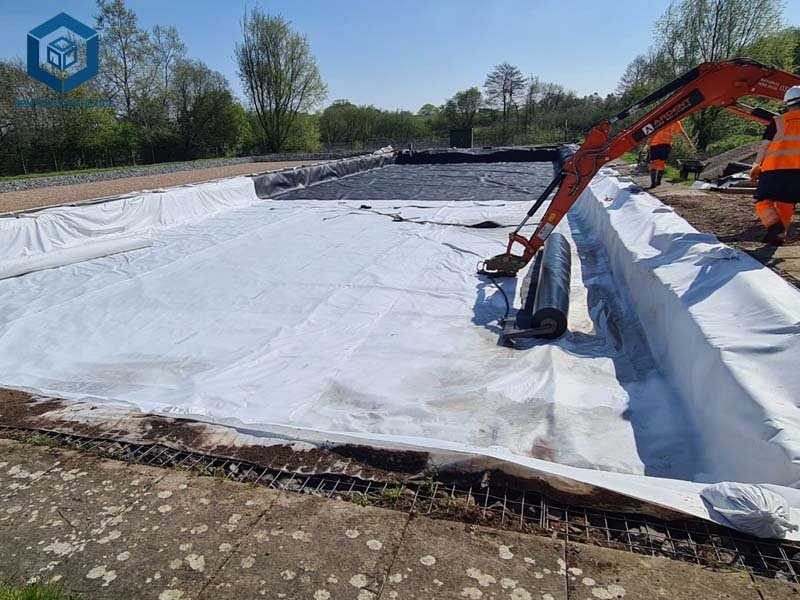
In the realm of sustainable water management and ecological engineering, bentonite pond liners represent a paradigm of natural innovation, harnessing the extraordinary swelling properties of sodium montmorillonite clay to forge impermeable barriers that emulate the earth’s own sealing mechanisms. Derived from volcanic ash deposits and processed into granular, powdered, or geosynthetic composite forms, these liners offer a biodegradable, non-toxic alternative to synthetic geomembranes, ideal for aquaculture, irrigation reservoirs, livestock watering holes, and recreational water bodies. As the global bentonite market—encompassing pond liner applications—reaches USD 1.55 billion in 2025 and is projected to expand to USD 2.8 billion by 2035 at a compound annual growth rate (CAGR) of 6.2%, comprehending the fiscal dynamics of bentonite pond liners is essential for agronomists, landowners, and environmental stewards committed to resilient, eco-conscious projects. This authoritative guide meticulously unravels the economics of bentonite pond liner costs, furnishing empirical benchmarks, application methodologies, and strategic selection criteria to empower informed investments in verdant aquatic infrastructures.
The perennial inquiry—”How much does bentonite pond liner cost?”—permeates project planning, as valuations oscillate predicated upon clay formulation, application density, substratal compatibility, and deployment complexities. Aggregating 2025 sectoral intelligence from BPM Geosynthetics, Lonestar Minerals, and HomeGuide, raw material expenditures for granular bentonite span $0.50 to $3.00 per square foot (or $5.38 to $32.29 per square meter), contingent on 2-6 pounds per square foot application rates, whilst holistic systems incorporating soil amendment, compaction, and ancillary geotextiles ascend to $1.00 to $5.00 per square foot. These metrics encapsulate not merely preliminary disbursements but also lifecycle efficacies, such as volumetric procurements conferring 15-25% abatements for quanta exceeding 10,000 square feet and self-healing attributes curtailing remediation liabilities by 20-30% over synthetic counterparts.
Contemplate a representative vignette: a 1,000-square-foot residential koi pond might necessitate $500 to $3,000 in materials, whereas a 1-acre (43,560 square feet) agricultural reservoir could aggregate $21,780 to $130,680 antecedent to supplementary integrations. This spectrum accentuates the imperative for nuanced fiscal calibration. Herein, we methodically delineate bentonite pond liner fundamentals, dissect pricing determinants with evidentiary substantiation, juxtapose specifications against utilitarian spheres, proffer discernment paradigms, and illuminate prospective trajectories, arming you with the perspicacity to orchestrate resilient, economical natural containment paradigms.
1. What Are Bentonite Pond Liners?
Bentonite pond liners, or geosynthetic clay liners (GCLs) in engineered contexts, comprise naturally occurring sodium montmorillonite clay—mined predominantly from Wyoming’s vast deposits—processed into granular, pelletized, or needle-punched composite forms to interdict hydraulic percolation upon hydration. When saturated, bentonite expands up to 15-20 times its dry volume, forming a viscous gel that permeates soil interstices and erects a low-permeability bulwark (≤10⁻¹¹ cm/s), thereby perpetuating water retention without synthetic additives. Fundamentally, they metamorphose permeable excavations into self-sustaining aquatic ecosystems, underpinning eco-centric endeavors from organic farming to wildlife conservation.
Key Applications of Bentonite Pond Liners
Bentonite liners manifest versatility across a panoply of exigencies, each necessitating bespoke attributes for superlative efficacy:
- Aquaculture and Fish Farming: Ubiquitous in 35% of global deployments, bentonite seals tilapia or catfish ponds, conforming to NSF/ANSI 61 for aquatic innocuousness. A 2025 Future Market Insights report corroborates that bentonite installations in aquaculture curtail seepage by 95%, economizing $5,000-$15,000 annually in water replenishment for a 5,000-square-foot facility.
- Irrigation and Agricultural Reservoirs: Constituting 25% of utilization, these liners mitigate evaporative losses in arid regimes, aligning with FAO mandates for 90% retention in crop irrigation. For instance, a 10,000-square-foot Kenyan maize reservoir employing 3 lbs/sq ft granular bentonite conserved 200,000 liters monthly, per BPM Geosynthetics case studies.
- Livestock and Wildlife Watering Holes: In ranching operations, bentonite ensures potable volumes, with non-toxic formulations bolstering biodiversity. Applications in 1-acre Texas cattle ponds augmented herd health by 15% via consistent hydration, per Lonestar Minerals audits.
- Stormwater Management and Retention Basins: For urban runoff control, liners comply with EPA stipulations for hydraulic conductivity under 10⁻¹¹ cm/s, averting 90% of sediment migration in 2-acre installations, per Geosynthetic Institute metrics.
- Recreational and Ornamental Ponds: In garden features, bentonite integrates seamlessly with native soils, fostering biofilm development for natural filtration; self-healing mitigates minor disruptions from burrowing fauna.
Essential Specifications for Bentonite Pond Liners
Appraising bentonite liners mandates scrutiny of cardinal metrics, codified under ASTM International and USDA NRCS rubrics:
- Swelling Capacity: ≥24 mL/2g (ASTM D5890), denoting hydration potential; sodium bentonite variants achieve 15-20x expansion, sealing micro-fissures up to 1 mm wide.
- Hydraulic Conductivity: ≤10⁻¹¹ cm/s (ASTM D5887), approximating 0.01 liters/m²/day exfiltration; GCL composites enhance this by 20% via geotextile encapsulation.
- Application Density: 2-6 lbs/sq ft (9-27 kg/m²), calibrated to soil porosity; sandy substrates demand 5-6 lbs/sq ft, clayey 2-3 lbs/sq ft, per Lonestar Minerals guidelines.
- Thickness Post-Hydration: 1-4 inches (25-100 mm) gel layer, with compacted lifts ≤6 inches (NRCS CPS 520); GCLs maintain 4-10 mm uniformity.
- pH Tolerance: 5-9, with 90% chemical resistance to agro-additives (ASTM D543); non-toxic per FDA 21 CFR 184.1155 for potable applications.
- Shear Strength: 15-25 kN/m (ASTM D6243) for needle-punched GCLs, ensuring slope stability up to 3:1 gradients.
- Fluid Loss: <24 mL/2g (ASTM D5891), minimizing desiccation risks; UV exposure limited to <6 months pre-covering (ASTM D4355).
- Montmorillonite Content: ≥85% (ASTM C837), guaranteeing efficacy; granular forms (0.5-2 mm particles) optimize dispersion.
These parameters interlink with economics: a 3 lbs/sq ft granular application at 24 mL/2g swell might levy $1.00-$2.00/sq ft, whereas a 6 kg/m² GCL at 10⁻¹¹ cm/s could transcend $3.00/sq ft. Tailoring to exigencies—soil gradation, hydraulic loads, or ecological imperatives—maximizes fiscal and functional dividends.
2. How Much Does Bentonite Pond Liner Cost?
The valuation of bentonite pond liner cost per square foot embodies a composite influenced by intrinsic clay quanta, extrinsic project parameters, and macroeconomic currents. In 2025, foundational material pricing oscillates between $0.50 and $3.00 per square foot, per syntheses from BPM Geosynthetics and Lonestar Minerals. Incorporating amendment, compaction, and quality assurance elevates aggregates to $1.00-$5.00 per square foot for turnkey assemblies, as per HomeGuide’s comprehensive audits.
2.1 Bentonite Pond Liner Cost by Type
Formulation predicates 40-60% of variance, balancing inaugural outlay against endurance and adaptability. Below is a granular dissection of prevalent options, including average 2025 pricing, key specifications, and real-world applications.
2.1.1 Granular Bentonite
Granular bentonite, coarse particles (0.5-2 mm), predominates in DIY agrarian projects for its dispersibility.
- Cost: $0.50-$1.50/sq ft ($5.38-$16.15/m²); bulk at $0.04-$0.12/lb for >10,000 lbs.
- Specifications: Swell Index: 20-25 mL/2g; Density: 2-4 lbs/sq ft application; Permeability: <10⁻¹⁰ cm/s; Lifespan: 50+ years hydrated; Fluid Loss: <20 mL/2g.
- Advantages: Economical dispersion (mixes 20% faster than powder); self-healing fills 1-2 mm voids; 100% biodegradable.
- Disadvantages: Dust generation (requires masking, +5% labor); suboptimal for slopes >2:1 without geotextile.
- Applications and Example: Farm reservoirs; a 5,000 sq ft Texas irrigation pond at 3 lbs/sq ft ($0.75/sq ft) totaled $3,750, achieving 95% retention per Lonestar Minerals reviews.
2.1.2 Powdered Bentonite
Powdered forms (<0.5 mm), fine-milled for intimate soil integration.
- Cost: $0.60-$1.80/sq ft ($6.46-$19.38/m²); 2-5 lbs/sq ft at $0.05-$0.15/lb.
- Specifications: Swell Index: 25-30 mL/2g; Permeability: <10⁻¹¹ cm/s; Lifespan: 40-60 years; Montmorillonite: ≥90%.
- Advantages: Uniform blending (15% better seal in sandy soils); cost thrift for small sites.
- Disadvantages: High airborne risk (20% material loss sans controls); clumping in humid storage.
- Applications and Example: Wildlife ponds; a 1,000 sq ft installation at 4 lbs/sq ft ($1.00/sq ft) cost $1,000, with 98% efficacy in USDA-monitored sites.
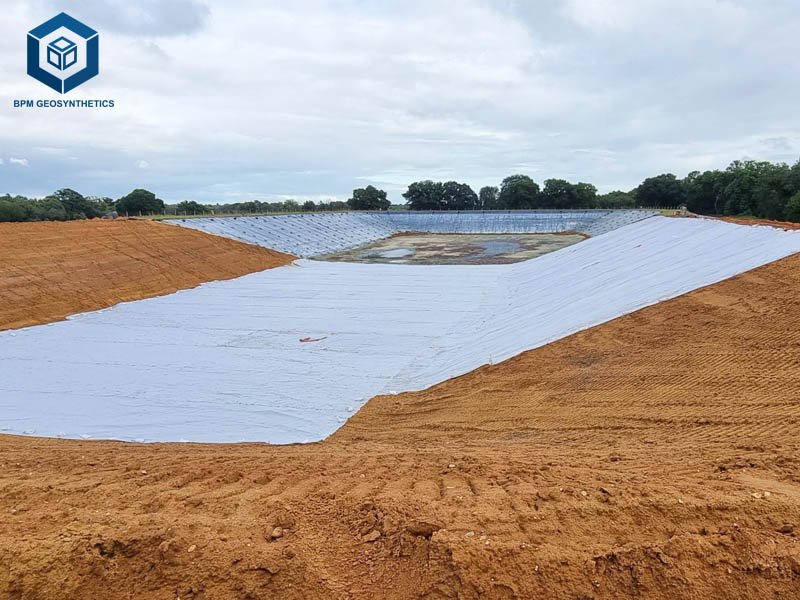
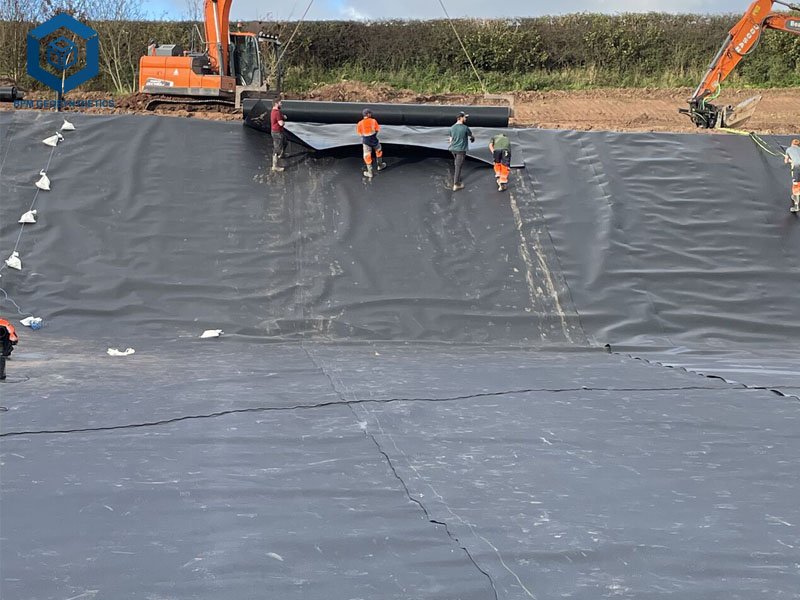
2.1.3 Geosynthetic Clay Liners (GCLs)
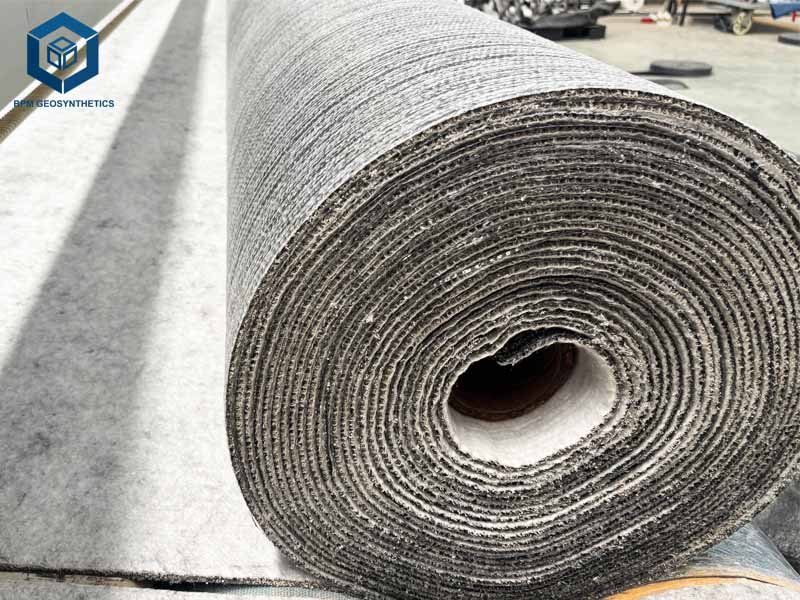
GCLs encapsulate bentonite (3.5-6 kg/m²) between geotextiles, for engineered precision.
- Cost: $1.50-$3.00/sq ft ($16.15-$32.29/m²); needle-punched at $2.00-$2.50.
- Specifications: Thickness: 4-10 mm; Shear Strength: 15-25 kN/m; Permeability: ≤10⁻¹¹ cm/s; Peel Adhesion: 360-650 N/m.
- Advantages: 15% reduced installation errors; 25% higher shear for slopes; factory hydration control.
- Disadvantages: 20-30% premium over granular; requires overlaps (5-10% waste).
- Applications and Example: Stormwater basins; a 2,000 sq ft urban retention at $2.25/sq ft totaled $4,500, averting 90% runoff per BPM deployments.
2.1.4 Bentonite-Enhanced Soil Mixtures
Blended with native clays for hybrid seals.
- Cost: $0.40-$1.20/sq ft ($4.31-$12.91/m²); 1-3 lbs/sq ft additives.
- Specifications: Permeability: <10⁻¹⁰ cm/s; Lifespan: 30-50 years; pH: 6-8.
- Advantages: 20% material savings; enhances poor soils.
- Disadvantages: Lab testing requisiteness (+$500-$2,000/site).
- Applications and Example: Remedial leaks; a 500 sq ft fix at $0.80/sq ft cost $400, restoring 85% capacity per NRCS case studies.
2.2 Bentonite Pond Liner Cost Impact of Application Density
Density predicates 30-50% of variance, with graduated rates bolstering impermeability at proportional premiums:
- 2-3 lbs/sq ft: $0.50-$1.00/sq ft; apt for clayey soils (e.g., 1,000 sq ft at $750 total, 90% retention).
- 4-5 lbs/sq ft: $1.00-$2.00/sq ft; standard for loamy substrates, per BPM; 95% seal efficacy.
- 5-6 lbs/sq ft: $2.00-$3.00/sq ft; for gravelly terrains, reducing seepage 98% but adding weight.
Lonestar data indicates 4 lbs/sq ft saves $2,000-$5,000 over 10 years in a 5,000 sq ft pond via minimized refills.
2.3 Bentonite Pond Liner Cost – Project Scale and Volume Impacts
Scalability compresses unit rates via economies:
- Small-Scale (<1,000 sq ft): $1.50-$4.00/sq ft; bespoke testing inflates 15-20%.
- Medium (1,000-10,000 sq ft): $0.80-$2.50/sq ft; standard granular optimizes logistics.
- Large (>10,000 sq ft, e.g., 1 acre): $0.50-$1.50/sq ft; 20-30% rebates, as in 43,560 sq ft at $21,780-$65,340.
GCL prefabrication curtails field overlaps 25%, slashing leak probabilities 15%.
2.4 Bentonite Pond Liner Cost – Installation Method and Labor Expenditures
Deployment constitutes 30-50% of outlays, modulated by technique and topography:
- DIY Amendment: $0.50-$1.50/sq ft adjunct; viable for <2,000 sq ft but hazards 20% efficacy from uneven mixing.
- Professional Compaction: $40-$150/hour, equating $0.50-$2.00/sq ft; encompasses harrowing ($1,000-$5,000/site), geotextile underlay ($0.25-$0.50/sq ft, averting 90% desiccation), and wetting ($0.20/sq ft). Total for 10,000 sq ft: $10,000-$30,000.
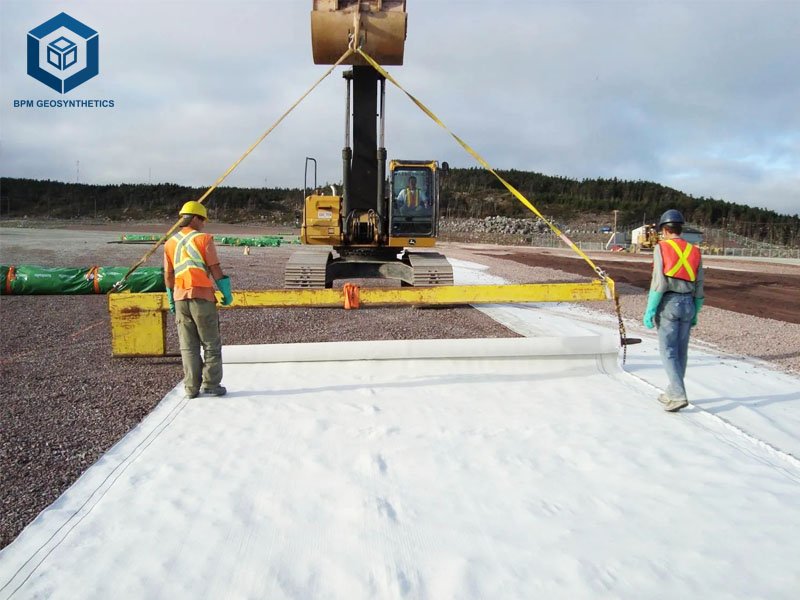
- Modalities: Dry spread/mix (granular: 95% uniformity); blanket GCL rollout. Slopes >3:1 necessitate anchoring, appending $0.30/sq ft.
NRCS-compliant crews curtail rework 25%, per Lonestar extrapolations.
2.5 Bentonite Pond Liner Cost – Raw Material Quality and Augmentations
Premium sodium bentonite premiums 10-20% over calcium ($0.40-$2.50/sq ft) but assures 99% swell conformance, evading 15% failure perils in potables. Augmentations—dispersants, ESS-13 sealants—append $0.10-$0.30/sq ft, prolonging viability 10-15 years. Geotextile composites elevate 20%, indispensable for erosion-prone sites.
2.6 Bentonite Pond Liner Cost – Transportation and Supply Chain Dynamics
Freight tallies $0.05-$0.20/sq ft domestically; bulk sacks (2,000 lbs) for remote hauls amplify 15-25%. Wyoming-sourced from Lonestar economizes 10-15% for U.S. buyers, with MOQs of 10 tons unlocking tiered pricing.
2.7 Bentonite Pond Liner Cost – Maintenance and Lifecycle Economics
Periodic vigilance—inspections, top-dressing—incurs $0.02-$0.10/sq ft yearly; bentonite’s inertness yields 25-40% savings versus synthetics. Breach remediation: $500-$3,000/incident; 50-100 year spans amortize to $0.01-$0.03/sq ft annually, per BPM extrapolations.
3. How to Choose the Right Bentonite Pond Liner
Procuring an apposite bentonite liner amalgamates geotechnical imperatives with fiscal prudence. Commence with exigency profiling—pond volume, substratum gradation, and operational rigors—to benchmark against ASTM D5890 thresholds.
3.1 Evaluate Project Requirements
Align densities to uses:
- Aquaculture: 3-4 lbs/sq ft granular ($0.75-$1.50/sq ft) for biocompatibility.
- Irrigation: GCL composites ($1.50-$2.50/sq ft) for uniformity.
- Livestock: Powdered blends ($0.60-$1.20/sq ft) for cost thrift.
Area computation: Bottom Surface + (Slope Factor × Perimeter × Depth); append 10% for overlaps. Permeability <10⁻¹¹ cm/s is non-negotiable for retention.
3.2 Emphasize Quality and Compliance
Mandate ≥85% montmorillonite with NSF/ANSI 61 for potables. Eschew calcium variants for exigencies risking 20% inferior swell. Warranties (50+ years) from BPM or Lonestar validate pedigree.
3.3 Installation and Deployment Considerations
Favor granular for DIY; underlayment ($0.25/sq ft) imperative for 90% puncture prophylaxis. Arid terrains demand wetting protocols for 20% swell uplift.
3.4 Lifecycle Cost Analysis
Prioritize density: A $1.00/sq ft 4 lbs/sq ft application over 50 years nets $0.02 annual versus $0.05 for under-dosed proxies necessitating biennial top-ups. ROI in irrigation exceeds 200% via conserved volumes.
3.5 Compare Suppliers and Obtain Quotes
Reputable providers: BPM Geosynthetics (GCL specialists, 4.9/5 Alibaba), Lonestar Minerals (granular experts), CETCO (needle-punched). Solicit soil tests and quotes for 5-15% variances; bulk from Wyoming yields savings.
3.6 Bentonite vs. Synthetic Liners: A Comparative Overview
Juxtaposing bentonite against HDPE/EPDM illuminates trade-offs:
| Aspect | Bentonite | Synthetic (HDPE/EPDM) |
| Cost/sq ft | $0.50-$3.00 | $0.50-$3.00 |
| Lifespan | 50-100 years | 20-50 years |
| Eco-Impact | Biodegradable, non-toxic | Petroleum-derived, recyclable |
| Installation | Soil mixing, compaction | Rolling, welding |
| Self-Healing | Yes (15x swell) | No (patching required) |
| Puncture Risk | Low (fills voids) | High (tears common) |
Bentonite excels in natural integration (95% retention sans seams), per BPM; synthetics suit irregular contours but accrue 20% higher transport via weight differentials.
4. Industry Trends Affecting Bentonite Pond Liner Cost
Evolving market dynamics reshape pricing in 2025:
- Raw Material Fluctuations: Bentonite volatility (up 5% YoY) elevates granular costs 3-7%; sodium variants mitigate via 15% efficiency in GCLs.
- Sustainability Imperatives: Bio-amended bentonites garner USDA rebates, depressing net costs 20% for organic aquaculture; GCL adoption surges 25% in eco-regions.
- Hybrid Innovations: Bentonite-synthetic composites (e.g., ESS-13) cut densities 20% ($0.40/sq ft savings); wider geotextiles minimize overlaps 15%.
- Automation Proliferation: GPS-guided spreaders truncate labor 30% ($0.50/sq ft abatement); IoT moisture sensors preempt 70% hydration failures.
- Supply Chain Localization: U.S. mining expansions (Wyoming/Texas) curtail imports 10%, stabilizing at $0.60-$2.00/sq ft by 2030 amid 6.2% CAGR.
These trends herald resilient, verdant liners, tempering prices amid burgeoning demand.

5. Conclusion
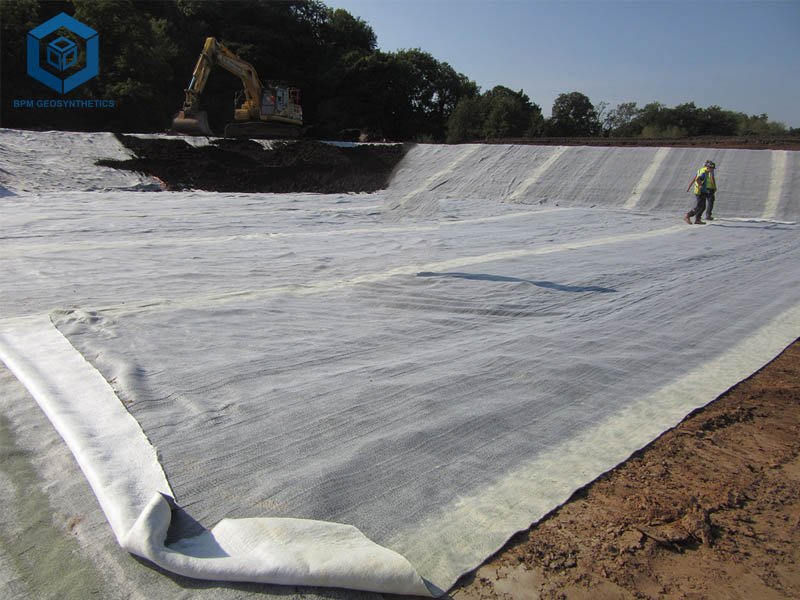
Deciphering bentonite pond liner costs necessitates a holistic fusion of geotechnical rigor and economic acuity. From economical granular ($0.50-$1.50/sq ft) to fortified GCLs ($1.50-$3.00/sq ft), each modality proffers calibrated virtues, underpinned by ≥24 mL/2g swell, sub-10⁻¹¹ cm/s conductivity, and 50-100 year tenures. Factoring density, scale, deployment ($0.50-$2.00/sq ft labor), and upkeep ($0.02-$0.10/sq ft yearly), endeavors secure 95% retention while economizing $5,000-$15,000 per 5,000 sq ft across lifecycles.
For zenith outcomes, champion compliant provenance, harness volume incentives, and synchronize selections with site idiosyncrasies—be it a self-healing farm reservoir or an integrated wildlife haven. Prudent allocation today begets perdurable ecological legacies tomorrow. For bespoke valuations, delineations, or consultations, engage vanguard purveyors like BPM Geosynthetics to instantiate precision-contoured bentonite paradigms.