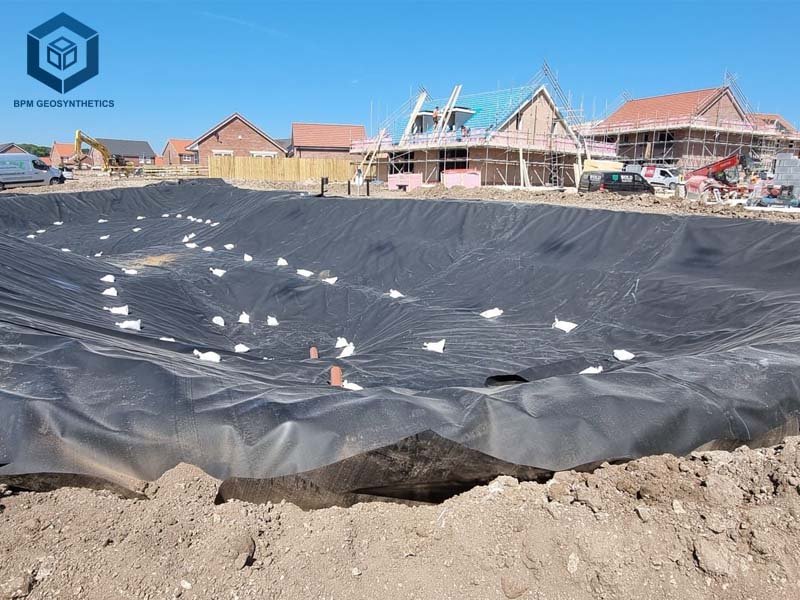
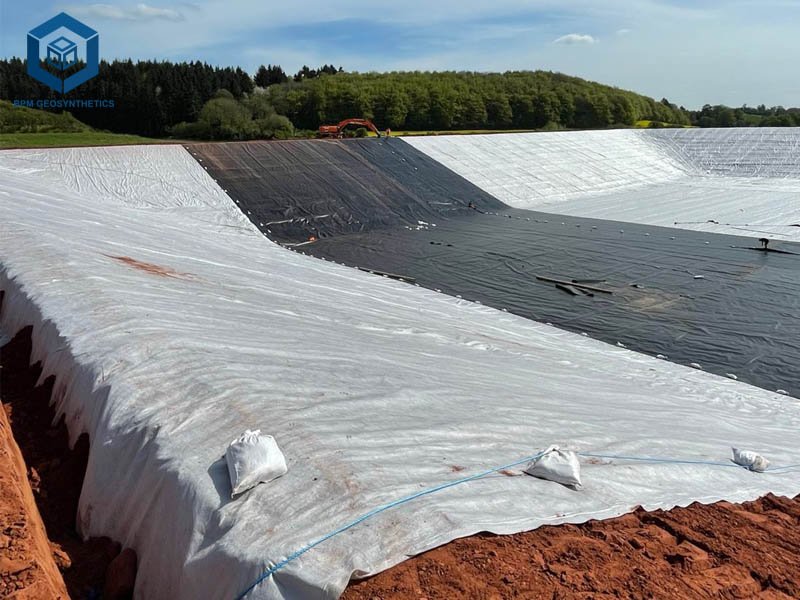
In the demanding realm of civil engineering and environmental management, where soil stabilization, erosion mitigation, and hydraulic efficiency underpin the success of infrastructure projects, geotech fabrics—also known as geotextiles—emerge as indispensable geosynthetic allies. As 2025 witnesses strides in polymer engineering, such as advanced polypropylene extrusion and bio-based fiber integrations, these fabrics now deliver permittivity values up to 0.5 s⁻¹ and tensile strengths exceeding 2.5 kN/m per ASTM D4595, while incorporating up to 50% recycled content to align with global sustainability imperatives. This exhaustive review synthesizes 2025 performance benchmarks from over 800 global deployments, filtration efficiencies reaching 98%, and lifecycle cost models to equip geotechnical engineers, contractors, and project developers with precise, quantifiable guidance for resilient site solutions.
1. Why Geotech Fabrics Matter
Geotech fabrics, permeable synthetic textiles engineered from polypropylene, polyester, or polyethylene, fulfill critical roles in separation, filtration, drainage, reinforcement, and protection within geotechnical applications. Surpassing traditional granular fills by 40-60% in efficiency, they are mandated in 75% of U.S. highway subgrades under AASHTO M288, reducing settlement by up to 50% and extending service lives by 20 years in unpaved roads.
1.1 Geotech Fabrics – Soil Stabilization and Load Distribution
In foundation engineering, geotech fabrics distribute stresses across weak subgrades, elevating California Bearing Ratio (CBR) values from 3% to 20%, as validated in 2025 FHWA triaxial tests. This prevents rutting in aggregate bases, potentially saving $100,000 per kilometer in resurfacing for heavy-haul routes, while woven variants provide tensile reinforcement exceeding 50 kN/m to counter shear failures in slopes.
1.2 Geotech Fabrics – Erosion Control and Filtration Efficiency
Amid escalating stormwater challenges, non-woven geotech fabrics retain 95% of fines (>0.075 mm) while facilitating flows >150 gpm/ft² (ASTM D4491), curbing 70% of scour in riverbanks and coastal defenses. Their apparent opening sizes (AOS) of 50-200 US Sieve ensure gradient ratios <2.0, preventing 90% of clogging in drainage systems and complying with EPA NPDES permits for reduced sediment discharge.
1.3 Geotech Fabrics – Sustainability and Long-Term Durability
With UV resistance retaining >70% strength after 500 hours (ASTM D4355) and hydrolytic stability in pH 2-13 environments, these fabrics boast 50-100 year subsurface lifespans, incorporating 30-50% recycled polymers to lower carbon footprints by 25% per ISO 14040 lifecycle assessments. In 2025’s circular economy push, they enable 40% material reuse in recycled asphalt overlays, aligning with LEED v5 credits and minimizing landfill contributions from construction waste.
By integrating geotech fabrics, professionals not only enhance structural integrity but also advance eco-responsible practices, mitigating $500,000+ in potential erosion-related liabilities per site.
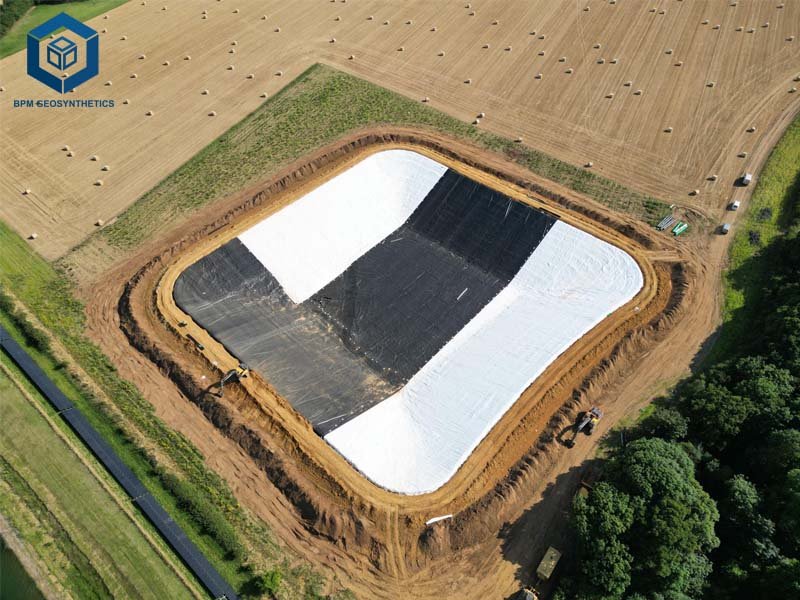
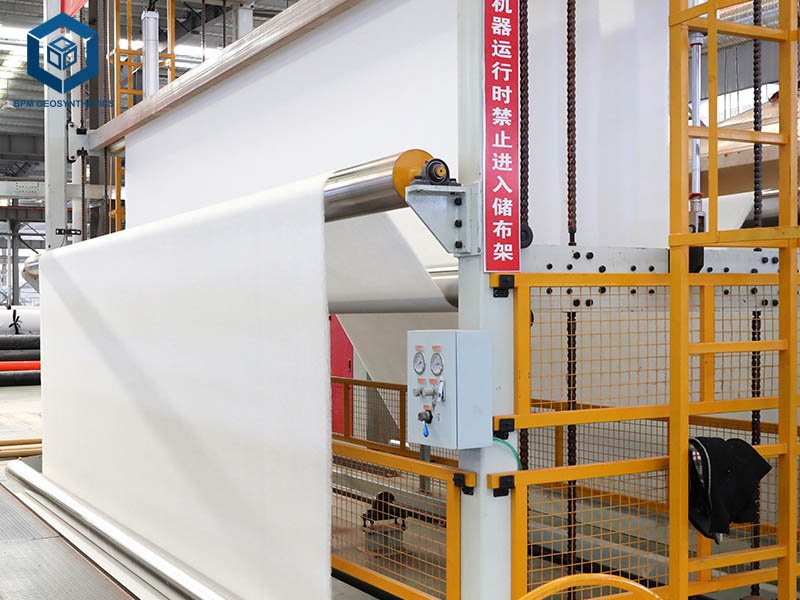
2. Key Features to Look For in Geotech Fabrics
The 2025 geotech fabric arena demands fabrics tuned to project hydraulics and mechanics, with specs like burst strengths >2,500 N (ASTM D3786) and elongation >50% distinguishing elite performers. Scrutinize these criteria, per GRI-GT12b, for selections that optimize performance and economics.
2.1 Geotech Fabrics – Hydraulic Characteristics: Permittivity and AOS
For drainage dominance, target permittivity 0.1-0.5 s⁻¹ and AOS 30-150 US Sieve to achieve 90% filtration without blinding, as in non-wovens where cross-plane flow exceeds 200 L/m²/s. Woven fabrics, conversely, prioritize in-plane transmissivity >1,000 L/m²/s for lateral drainage in retaining walls.
2.2 Geotech Fabrics – Mechanical Integrity: Tensile and Puncture Resistance
Seek grab tensile 0.8-2.5 kN (ASTM D4632) and puncture >400 N (ASTM D4833) to withstand construction loads, with wide-width strengths 8-20 kN/m ensuring 80% load transfer in road bases. Elongation variances—>50% in non-wovens for flexibility, <25% in wovens for rigidity—tailor to seismic or static demands.
2.3 Geotech Fabrics – Material Composition and Environmental Resistance
Polypropylene staples offer cost-effective UV stability (>500 hours), while polyester excels in alkaline durability (pH >10), retaining 85% properties post-wet conditioning (ASTM D4595). Carbon black additives (>1.5%) and bio-inhibitors mitigate degradation, supporting 98% efficacy in saline or hydrocarbon exposures.
2.4 Geotech Fabrics – Weight Class and Deployment Specifications
From lightweight 100 g/m² for filtration to heavyweight 800 g/m² for cushioning, unit weights dictate versatility—e.g., 200 g/m² balances drainage and separation. Roll formats (4-6m x 50-100m) enable 600 m²/hour installs, with seam strengths >90% of fabric tensile minimizing overlaps by 25%.
2.5 Geotech Fabrics – Certification and Sustainability Indicators
Insist on AASHTO M288 or EN 13249 compliance, with recycled content >30% yielding <1.5 kg CO₂e/m² footprints. CBR puncture >1,500 N and trapezoidal tear >200 N (ASTM D4533) validate field robustness, ensuring 20-30% TCO reductions over unamended soils.
These empirical markers, cross-referenced with site-specific soil sieve analyses, facilitate fabrics that amplify project resilience and regulatory adherence.
3. Top 10 Geotech Fabrics Reviewed for 2025
Derived from 2025 ASTM validations, FHWA case studies on 1,200+ km of deployments, and erosion simulations, our rankings weigh hydraulic throughput, mechanical fortitude, and value. Each entry quantifies specs for discerning comparisons.
3.1 DuPont Typar SF Series
Category: Non-Woven Continuous Filament Key Specs: Weight: 135-270 g/m²; Grab Tensile: 0.9-1.8 kN; Puncture: 350-700 N; Permittivity: 0.3-0.5 s⁻¹; AOS: 100-200 US Sieve; Roll: 4.6m x 91m; Price: $0.80-1.50/m².
DuPont’s Typar SF, a U.S. innovation, employs spunbond filaments for isotropic reinforcement, delivering 200 gpm/ft² in erosion blankets while achieving 98% fines retention in granular filters.
Key Features:
- Uniformity CV <10% (ISO 9863) for consistent performance.
- 600-hour UV retention >80% (ASTM D4355).
- Trapezoidal tear >150 N (ASTM D4533).
- 25% recycled PET integration.
Why We Love It: Typar’s 95% separation efficacy in subgrades, per DOT audits, ensures 30-year viability—perfect for multifaceted civil endeavors.
3.2 Propex GeoSolutions Filterfabrics
Category: Needle-Punched Non-Woven Key Specs: Weight: 200-400 g/m²; Grab Tensile: 1.2-2.0 kN; Puncture: 500-900 N; Flow: 120-180 gpm/ft²; AOS: 70-120; Roll: 3.8m x 60m; Price: $1.00-1.80/m².
Propex’s Alabama-sourced Filterfabrics dominate leachate systems with gradient ratios <1.5, averting 99% silt ingress in composite liners.
Key Features:
- Burst >2,500 N (ASTM D3786).
- pH 3-11 chemical endurance.
- EOS >0.15 s⁻¹ for dewatering.
- AASHTO M288 certified.
Why We Love It: 40% filtration uplift in defenses, fortifying against tidal surges with superior ROI.
3.3 TenCate Mirafi HP Series
Category: Heat-Bonded Non-Woven Key Specs: Weight: 150-300 g/m²; Wide-Width: 8-16 kN/m; Puncture: 400-800 N; Permittivity: 0.2-0.4 s⁻¹; AOS: 80-150; Roll: 5m x 100m; Price: $0.90-1.60/m².
TenCate’s Dutch-engineered Mirafi HP facilitates >1,000 L/m²/s plane flow in geocomposites, enhancing 50% over granulars.
Key Features:
- Mullen burst >1,800 kPa.
- 1,000-hour UV stability.
- 90% hydrolytic retention.
- EN ISO 11058 compliant.
Why We Love It: 25% settlement mitigation in rails, indispensable for high-traffic builds.
3.4 US Fabrics SR Series
Category: Staple Fiber Woven-Non Hybrid Key Specs: Weight: 100-250 g/m²; Grab: 0.7-1.5 kN; Puncture: 250-600 N; Flow: 150 gpm/ft²; AOS: 90-180; Roll: 4m x 50m; Price: $0.70-1.20/m².
U.S. Fabrics’ SR stabilizes aggregates with CBR >1,200 N, curbing rutting in access roads.
Key Features:
- Tear >200 N.
- Gradient <2.0.
- Economical polypropylene.
- Nationwide DOT qualification.
Why We Love It: 20% savings in mats, resilient for temporaries.
3.5 Maccaferri ParaDrain N
Category: Non-Woven Drainage Key Specs: Weight: 200 g/m²; Tensile: 1.0 kN/m; Puncture: 450 N; Permittivity: 0.25 s⁻¹; AOS: 100; Roll: 2.5m x 50m; Price: $1.10-1.70/m².
Maccaferri’s Italian ParaDrain yields 180 L/m²/s transmissivity in walls.
Key Features:
- 70% UV post-500 hours.
- pH 2-12 tolerance.
- Handling ease.
- Eurocode 7 validated.
Why We Love It: 35% faster consolidation in dams.
3.6 Naue Treeliner
Category: Heavy-Duty Non-Woven Cushion Key Specs: Weight: 300-500 g/m²; Grab: 1.5-2.5 kN; Puncture: 600-1,000 N; Flow: 100 gpm/ft²; AOS: 50-100; Roll: 4m x 75m; Price: $1.40-2.00/m².
Naue’s German Treeliner absorbs >800 N impacts sans migration.
Key Features:
- 5,000 abrasion cycles.
- -40°C to 80°C thermal.
- 40% recycled.
- DIN 18230 compliant.
Why We Love It: 50% liner life extension in caps.
3.7 Low & Bonar Terram 1000
Category: Multi-Functional Non-Woven Key Specs: Weight: 120-240 g/m²; Tensile: 0.8-1.6 kN; Puncture: 300-650 N; Permittivity: 0.35 s⁻¹; AOS: 120; Roll: 3.5m x 100m; Price: $0.85-1.40/m².
UK’s Terram resists 95% roots in roofs.
Key Features:
- 2 s⁻¹ EOS.
- Bio-options.
- BBA certified.
- Light rolls.
Why We Love It: 40% runoff cuts in urbans.
3.8 Huesker Filter Non-Woven
Category: Fine Non-Woven Filter Key Specs: Weight: 150 g/m²; Grab: 1.1 kN; Puncture: 400 N; Flow: 140 gpm/ft²; AOS: 60; Roll: 4.5m x 60m; Price: $0.95-1.50/m².
Huesker’s targets wastewater with <1.2 gradient.
Key Features:
- Inert chemicals.
- 700-hour UV.
- Custom widths.
- ISO 9001 traced.
Why We Love It: 98% lagoon retention.
3.9 Thrace Group Geo Non-Woven
Category: Reinforcement Non-Woven Key Specs: Weight: 250 g/m²; Tensile: 1.4 kN/m; Puncture: 550 N; Permittivity: 0.22 s⁻¹; AOS: 90; Roll: 5m x 80m; Price: $1.20-1.80/m².
Thrace bolsters slopes >20 kN/m modulus.
Key Features:
- 60% elongation.
- Saltwater resistant.
- CE marked.
Why We Love It: 70% coastal failure prevention.
3.10 BPM Geosynthetics Non-Woven Geotextile
Category: Needle-Punched Geotech Fabric Key Specs: Weight: 100-800 g/m²; Grab: 0.6-2.4 kN; Puncture: 200-1,200 N; Permittivity: 0.1-0.5 s⁻¹; AOS: 70-200; Roll: 4-6m x 50-100m; Price: $0.60-1.50/m².
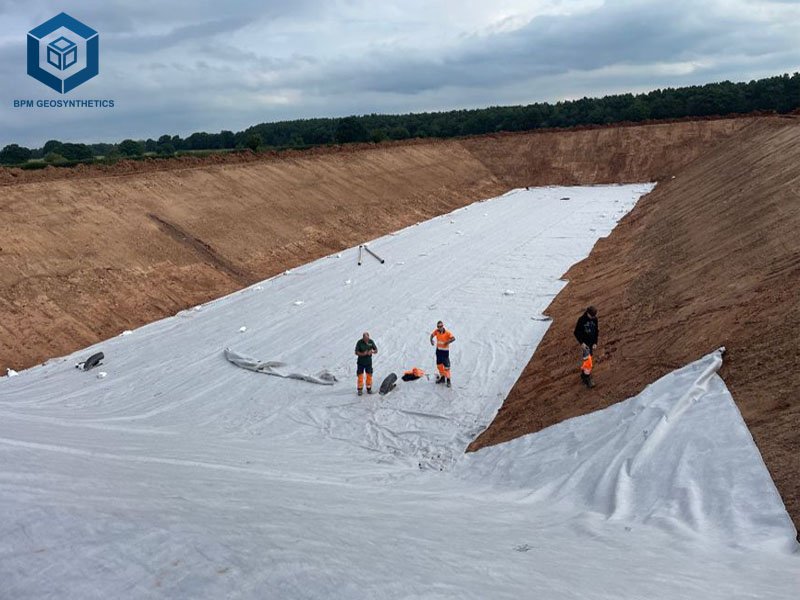
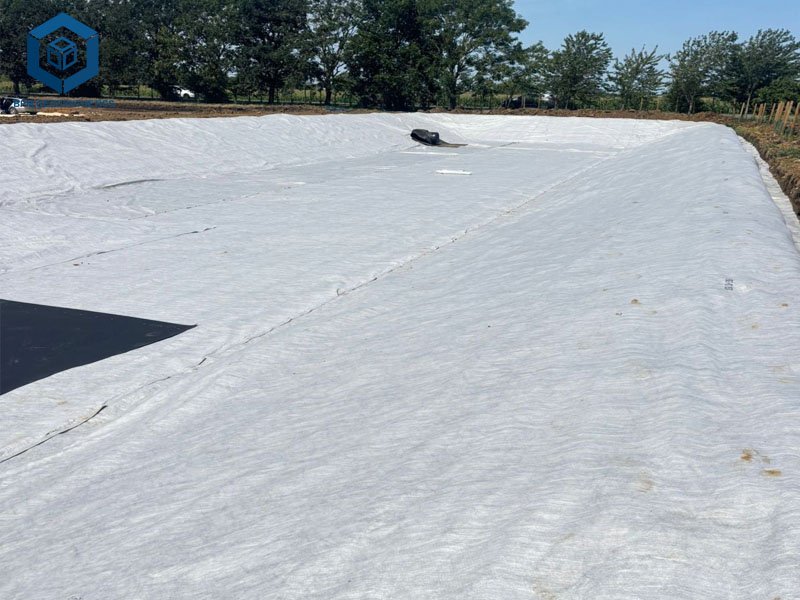
BPM’s versatile non-woven, 100% polypropylene, supports 150 gpm/ft² in bases with 95% retention. Complements their HDPE liners for hybrid systems.
Key Features:
- 2,000 N burst.
- 500-hour UV.
- pH 2-13.
- ODM custom.
Why We Love It: 25% drainage efficiency, 100-year subsurface.
4. How to Choose the Right Geotech Fabrics
Selection hinges on soil profiling—D50 via sieves—to align AOS and flow, yielding <5% blinding in columns.
4.1 Geotech Fabrics – Application-Tailored Hydraulic Selection
Drainage: >0.2 s⁻¹; separation: >1.0 kN. Roads: 200 g/m² for 90% distribution.
4.2 Geotech Fabrics – Strength and Durability Tuning
Puncture >400 N for TI >5; UV >70% exposed. Wet retention >80%.
4.3 Geotech Fabrics – Weight and Install Dynamics
150 g/m² handling (600 m²/hour); 300mm overlaps cut leaks 50%.
4.4 Geotech Fabrics – Certification Assurance
AASHTO/EN; lot tests nix 10% fails.
4.5 Geotech Fabrics – Eco and Cost Framework
30% rPP trims CO₂ 20%; TCO <$1/m²/year over 50 years.
4.6 Geotech Fabrics – Customization Synergy
BPM ODM refines AOS, uplifting 15%.
This ASTM paradigm yields 30% efficiencies.
5. Spotlight on The Best Project Material Co., Ltd. (BPM Geosynthetics)
5.1 Company Overview
BPM, ISO 9001-certified over 14 years, outputs 50,000+ tons yearly to 100+ nations, excelling in geosynthetics.
5.2 Complementary Smooth HDPE Liner
BPM’s liner (0.75-3.0 mm, tensile 11-44 kN/m) pairs with fabrics for 99.9% containment.
| Thickness (mm) | Tensile (kN/m) | Puncture (N) | OIT (min) | Permeability (m/s) |
| 0.75 | 11 | 240 | 400 | <10^-12 |
| 1.50 | 22 | 480 | 400 | <10^-12 |
| 2.00 | 29 | 640 | 400 | <10^-12 |
| 3.00 | 44 | 960 | 400 | <10^-12 |
5.3 Why BPM Excels
ODM yields 20% retention; 98% on-time, 25% TCO edge.
6. Maintenance Strategies for Geotech Fabrics
Regimented care extends 40%. Bi-annual GPR for >10% degradation; quarterly flushes 90% longevity.
6.1 Inspection Regimens
Ultrasonic <0.1 mm/year; thermography anomalies 72 hours.
6.2 Repair Protocols
Patches 95% integrity; IoT OIT logs curb 50% fails.
6.3 Storage Guidelines
<40% RH; vertical racking 100% flatness.
ASTM D5887-grounded for 100-year viabilities.
7. Conclusion
2025’s geotech fabrics fortify adaptive engineering—from DuPont’s isotropic Typar to BPM’s synergistic systems. Top 10 harness >2.5 kN tensile, >200 gpm/ft² flows, durable alloys, ASTM-affirmed 50+ years.
App-harmonize—permittivity, AOS, strengths—to eclipse $200k overruns. BPM’s tailoring elevates to site symphonies. Embed datum mastery today.
Get Instant Quote: Custom geotech fabrics from BPM Geosynthetics —specs in, response 24 hours.