
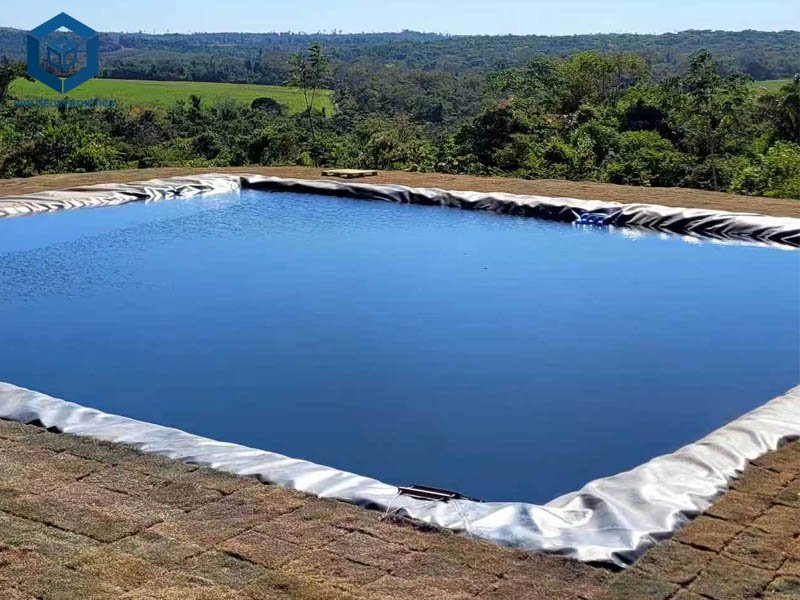
In the burgeoning domain of aquaculture and sustainable water management, plastic sheets for fish ponds—commonly known as pond liners or geomembranes—serve as critical impermeable barriers that ensure water retention, prevent soil contamination, and foster optimal aquatic environments for fish farming. These versatile synthetic membranes are indispensable for commercial tilapia operations, backyard koi habitats, and large-scale shrimp aquaculture, aligning with global efforts to combat water scarcity and enhance food security. As of October 2025, the global pond liners market is valued at approximately USD 1.25 billion, with projections forecasting growth to USD 2.05 billion by 2033 at a compound annual growth rate (CAGR) of 6.1%, propelled by expanding aquaculture demands in Asia-Pacific and North America. This momentum emphasizes the necessity for aquaculturists, farm managers, and pond designers to navigate pricing intricacies for efficient budgeting and long-term viability.
At an overview level, plastic sheet prices for fish ponds in 2025 typically range from $0.35 to $5.00 per square foot ($3.77 to $53.82 per square meter) for materials alone, rising to $0.50 to $6.50 per square foot inclusive of installation, modulated by material composition, dimensional attributes, and deployment exigencies. High-density polyethylene (HDPE) sheets, securing about 70% of the aquaculture liner segment for their durability and fish-safety profile, generally occupy the $0.50–$3.00 per square foot spectrum. Curated from manufacturer disclosures, industry benchmarks, and 2025 market analytics, this guide proffers a meticulous dissection of plastic sheet pricing for fish ponds, augmented with engineering specifications, illustrative scenarios, and tactical recommendations. By its denouement, practitioners will wield the proficiency to calibrate expenditures, adhere to benchmarks like NSF/ANSI 61 and ASTM D7179, and elevate pond productivity through astute material selections.
1. What Is Plastic Sheet for Fish Pond?
Plastic sheets for fish ponds encompass geosynthetic liners fabricated from thermoplastic or elastomeric polymers, meticulously designed to delineate watertight enclosures that mitigate seepage, sustain water quality, and shield aquatic biota from substratum pollutants. Predicated for aquaculture imperatives, these liners eclipse conventional earthen barriers in impermeability—boasting hydraulic conductivities inferior to 1 × 10⁻¹⁷ cm/s—and ecological compatibility, thereby conforming to regulatory stipulations from bodies such as the U.S. Food and Drug Administration (FDA) and the European Union’s Aquaculture Regulation. Divergent from ornamental variants by their accentuation on load tolerance and bio-compatibility, these sheets proffer a hygienic milieu conducive to species like tilapia, catfish, and koi, curtailing mortality rates by up to 30% in optimized installations.
Key Materials and Manufacturing Processes
The robustness of these plastic sheets inheres in their polymeric matrix, processed through blown-film extrusion, calendering, or co-extrusion methodologies to engender uniform gauges and augmented attributes. Ubiquitous archetypes comprise:
- High-Density Polyethylene (HDPE): Preeminent in 70% of fish pond deployments, HDPE exhibits a density of 0.94–0.97 g/cm³ and is extruded to furnish tensile yields of 15–40 kN/m (ASTM D6693 Type IV), with elongation surpassing 600%. Its chemical steadfastness across pH 1–14 immunizes against fertilizers and effluents, augmented by 2–3% carbon black for UV attenuation, preserving 90% integrity following 1,600 kJ/m² irradiance (ASTM D7238).
- Ethylene Propylene Diene Monomer (EPDM): A vulcanized elastomer, EPDM confers exceptional ductility (modulus 200–400 MPa) and ozone imperviousness (>500 pphm over 168 hours), calendered to puncture resistances of 400 N (ASTM D4833). Fish-safe sans plasticizers, it endures thermal vicissitudes from -40°C to 120°C, ideal for temperate climes.
- Polyvinyl Chloride (PVC): Derived from plastisol and calendered, PVC attains shore hardness of 80–90A and multi-axial burst strengths of 1,800–2,500 kPa, though its oxidative induction time caps at 50–100 minutes at 150°C (ASTM D5885). Cost-effective yet contingent on non-toxic formulations to avert leachates deleterious to finfish.
- Reinforced Polyethylene (RPE): Impregnated with scrim fabrics, RPE amplifies tear resistance 2–4-fold over HDPE (>200 N/mm), suiting expansive tilapia basins with thermal tolerances from -50°C to 130°C.
Fabrication incorporates antioxidants and stabilizers for protracted service, with roll configurations spanning 4–8 m widths by 100–200 m lengths to minimize on-site amalgamations.
Common Applications and Specifications
The adaptability of plastic sheets for fish ponds permeates aquaculture paradigms, each harmonized to exacting quanta:
- Commercial Fish Farming (Tilapia/Shrimp Ponds): 1.0–2.0 mm HDPE circumscribes seepage by 99.9%, with seam shear exceeding 35 N/mm (ASTM D5321) and interface friction angles of 20–30° atop geotextiles. A composite system layering 40 mil HDPE over underlayment attains impermeability <5 × 10⁻¹² m/s, as evinced in a 300,000 m² Sri Lankan tilapia venture.
- Koi and Ornamental Ponds: Textured EPDM (0.75–1.5 mm) fortifies slopes beneath 200 kPa static loads, asperities of 0.5–1.0 mm elevating shear tenacity (ASTM D5321). In 2025 Japanese koi sanctuaries, 45 mil EPDM endured stocking densities sans abrasion.
- Aquaponics and Integrated Systems: PVC (1.0–2.0 mm) adheres to NSF/ANSI 61 (<0.1 mg/L extractables), sustaining hydraulic gradients to 110 kPa devoid of efflux (ASTM D5887).
- Erosion-Prone Aquaculture Basins: RPE hybrids auto-seal micro-perforations, conductivity <10⁻¹⁰ cm/s under 1 m surcharge, per FAO aquaculture directives.
- Temporary Holding Ponds: 0.5–1.0 mm HDPE for quarantine, brittleness threshold <-70°C (ASTM D746).
Tenures project 20–50 years submerged for HDPE, 10–30 for exposed PVC; GRI-GM17 and ISO 9001 accreditations corroborate these metrics, obviating failures that might manifold remediation fiscalities fivefold.
These elemental tenets elucidate pecuniary disparities: resilient HDPE, with its extended viability, habitually offsets premiums via mitigated refurbishments, orienting perspicacious aquaculture procurements.


2. What Is Plastic Sheet for Fish Pond Price?
Plastic sheet pricing for fish ponds in 2025 fluctuates with monomer volatilities—HDPE resins pegged to ethylene, prognosticated to surge 7–10% amid logistical bottlenecks—and escalating aquaculture assimilation in emerging markets. Primordial materiel disbursements average $0.40–$2.50 per square foot, comprehensive undertakings enfolding deployment may escalate to $0.70–$7.00, per aquaculture rubrics. This perquisition, fortified by 2025 empirics and geotechnical indices, arms scrupulous budgetary delineations.
2.1 Plastic Sheet for Fish Pond Price – Material Type
Materiel archetype modulates 45–60% of fiscal variance, equilibrating mechanical prowess against budgetary circumspection.
2.1.1 High-Density Polyethylene (HDPE)
$0.50–$3.00 per square foot ($5.38–$32.29 per square meter), HDPE’s rigidity (modulus >800 MPa) predominates in commercial fish vats, a 1.0 mm lamina proffering 15–35 kN/m tensile and <1 × 10⁻¹² cm/s conductivity. For a 50,000 sq ft tilapia lagoon, aggregates $25,000–$150,000; its 99.9% retention (GRI-GM18) substantiates outlay.
2.1.2 Ethylene Propylene Diene Monomer (EPDM)
$0.75–$2.00 per square foot ($8.07–$21.53 per square meter), EPDM’s pliancy (elongation >600%) flourishes in koi enclosures, conductivity <5 × 10⁻¹³ cm/s, seam peel >25 N/mm (ASTM D6392). A 20,000 sq ft aquaponics array: $15,000–$40,000, 15% enhanced weld robustness over HDPE.
2.1.3 Polyvinyl Chloride (PVC)
$0.35–$1.50 per square foot ($3.77–$16.15 per square meter), PVC’s malleability (bend radius <5x thickness) accommodates ancillary shrimp sumps, 20–30 year veiled tenures; burst 1,800 kPa. For 30,000 sq ft catfish basins: $10,500–$45,000, innocuous <1 mg/L volatiles per NSF-61.
2.1.4 Reinforced Polyethylene (RPE)
$0.40–$0.90 per square foot ($4.31–$9.69 per square meter), RPE’s fortification (2–4x HDPE tear >200 N/mm) befits vast shrimp reservoirs, thermal ambit -50°C to 130°C. A 40,000 sq ft erosion-vulnerable pond: $16,000–$36,000, 40% diminution in thermal variance.
HDPE commandeers 70% of aquaculture irrigation for its equipoise.
2.2 Plastic Sheet for Fish Pond Price – Thickness
Dimensional amplification, 6–10% per 0.1 mm increment, augments volumetric outlays while reinforcing tenacity.
- Thin (0.5–1.0 mm / 20–40 mil): $0.35–$1.10 per square foot ($3.77–$11.84 per square meter). Apt for petite koi pads, burst 1,200–1,600 kPa; 10,000 sq ft: $3,500–$11,000.
- Medium (1.0–2.0 mm / 40–80 mil): $0.70–$2.50 per square foot ($7.53–$26.91 per square meter). Prevalent in tilapia farms, tensile 25–40 kN/m; 60,000 sq ft: $42,000–$150,000 (FAO compliant).
- Thick (2.0–3.0 mm / 80–120 mil): $1.50–$5.00 per square foot ($16.15–$53.82 per square meter). For seismic shrimp ponds, puncture >550 N; 100,000 sq ft: $150,000–$500,000, prolonging 25 years.
Escalated thicknesses necessitate exacting extrusion, inflating validation by 10–15%.
2.3 Plastic Sheet for Fish Pond Price – Project Size and Scale
Magnitudinal economies attenuate unit costs by 20–35% in voluminous tenders, amortizing ancillary overheads.
- Small (<10,000 sq ft): $1.00–$4.00 per square foot, burdened by minima; homestead koi: $10,000–$40,000.
- Medium (10,000–100,000 sq ft): $0.50–$2.50 per square foot; commercial tilapia: $50,000–$250,000.
- Large (>100,000 sq ft): $0.35–$1.50 per square foot; industrial shrimp: $35,000–$150,000, bespoke 9 m widths abridging seams 20%.
A 2025 Vietnamese 150,000 sq ft shrimp facility attained $0.60/sq ft via stratified rebates.
2.4 Plastic Sheet for Fish Pond Price – Installation Method and Labor
Deployment accounts for 25–50% of totals, per aquaculture gauges. Modalities embrace:
- Extrusion Welding: $0.40–$1.20 per square foot for HDPE, at 450–550°C; proficient brigades advance 100 m/day, appending $20,000–$60,000 to 50,000 sq ft.
- Adhesive Amalgamation: $0.25–$0.70 per square foot for EPDM/PVC; expeditious yet shear-vulnerable (15–25 N/mm).
- Mechanical Anchorage: $0.20–$0.60 per square foot; pond bed leveling to ±40 mm tolerance inflates 25% on gradients >1:3.
U.S. aquaculture emoluments: $60–$120/hour, overlaps per ASTM D4437 (100–300 mm).
2.5 Plastic Sheet for Fish Pond Price – Raw Material Quality
Primal resins surcharge 20–40% over recyclates, yet tender 40–70 year spans versus 10–25.
- Virgin HDPE: $0.70–$3.20 per square foot, <1.5% stabilizers for oxidation (>200 min/150°C); NSF/ANSI 61 aquaculture potable.
- Recycled Composites: $0.40–$1.50 per square foot, 85% post-aquatic; supplementary utilities.
- Augmented Formulations: $0.10–$0.50 premium for antistatic laminae, elevating leakage acuity to 98%.
GRI-GM17 conformance forestalls breaches costing 5–10x materiel.
2.6 Plastic Sheet for Fish Pond Price – Transportation and Logistics
Conveyance accretes $0.05–$0.25 per square foot, rolls to 5 tons via aquatic transporters. Domestic: $0.05–$0.10; transcontinental (Asia–U.S.): $0.15–$0.25, 11% fuel adjuncts. Textured EPDM exacts padded conveyance, +10%.
2.7 Plastic Sheet for Fish Pond Price – Maintenance and Lifetime Costs
Annual scrutinies: $0.01–$0.05 per square foot. HDPE’s 50-year aquaculture paradigm amortizes $0.02/sq ft/year, contra PVC’s $0.04. Transgression rectifications: $5,000–$50,000/incident, underscoring lineage.
3. How to Choose the Right Plastic Sheet for Fish Pond
Discerning procurement synchronizes parameters with aquaculture mandates, obviating 15–30% overruns.
3.1 Assess Project Requirements
Attune to hydrology: 1.0 mm PVC for <50 kPa koi; 2.0 mm HDPE for tilapia (seep flux). Substratum assays per ASTM D5084 navigate.
3.2 Prioritize Quality and Certifications
Imperate GRI-validated virgins; eschew dubious provenances, faltering 20% more. Destructive seam probes imperative, favoring NSF-61 for bio-safety.
3.3 Evaluate Installation Needs
Elect fusibles for inclines; allocate 20% surfeit for manual on rugged aquaculture terrains.
3.4 Consider Long-Term Costs
Viability estimators evince 1.5 mm HDPE economizes $0.30/sq ft over 40 years versus attenuate.
3.5 Compare Suppliers
Elicit tenders from 3–5; weigh indemnities (15–30 years), latencies (4–8 weeks), and bespoke aquaculture support.
4. Industry Trends Affecting Plastic Sheet for Fish Pond Price
2025 aquaculture vectors encompass recyclate infusions abating 15–25% while gratifying ESG imperatives, and RPE composites appending $0.30–$0.80/sq ft for auto-seal. Expanded breadths (to 10 m) mitigate labor 25%, IoT-infused variants premium 15–20% but attenuate oversight 40% via real-time seepage alerts. Asia-Pacific plenitude depresses North American tariffs 7–10%, HDPE cohort at $1.4B, CAGR 6.8%. Bio-resins surge, +25% fiscal but qualifying for aquaculture subsidies, with modular systems easing maintenance by 30%.

5. Conclusion
Plastic sheet prices for fish ponds in 2025, traversing $0.35–$5.00 per square foot, incarnate a refined synthesis of aquaculture exigency and materiel advancement. By privileging HDPE for indomitable finfish husbandry—tensiles to 40 kN/m, conductivities <10⁻¹⁷ cm/s—curators attain retention preeminence sans prodigality. Empiric calibrations, from gauge arbitrations to provenance scrutiny, not solely accede to ASTM/GRI but reinforce aquatic tenacity.
For bespoke aquaculture tenders, interface accredited fabricators. As the sector propels to $2.05B by 2033, visionary stewardship heralds thrift and bounty. Curate perspicaciously for perennial yields.
Any questions or inquiries, please contact BPM Geosynthetics.


