
In the evolving landscape of environmental engineering and sustainable infrastructure, Geo membranes serve as critical barriers for containment, isolation, and anti-seepage applications. As 2025 unfolds with heightened regulatory scrutiny—such as the EPA’s stringent leachate management protocols and the EU’s Circular Economy Action Plan—selecting superior Geo membranes is paramount for ensuring project resilience and compliance. This in-depth review evaluates 12 premier geomembranes, leveraging the latest ASTM and GRI-GM13 standards, real-world performance data, and lifecycle analyses to deliver actionable insights. Standout among them is the HDPE Geomembrane from BPM Geosynthetics, manufactured by The Best Project Material Co., Ltd, renowned for its HeatGard® bimodal resin technology and unwavering adherence to global benchmarks.
From landfills and mining tailings to aquaculture ponds and reservoir linings, these Geo membranes provide exceptional impermeability, chemical resistance, and durability. Sourced exclusively from non-Chinese manufacturers in North America, Europe, and allied regions, our selections prioritize supply chain transparency and accessibility for international endeavors. Backed by Geosynthetic Institute validations showing up to 99.9% seepage prevention, this guide equips engineers, contractors, and procurement specialists with the data-driven knowledge to optimize their containment strategies. Dive in to explore specifications, applications, and strategic value that drive long-term success.
1. Why Geo membranes Matter
Geo membranes represent the vanguard of geotechnical innovation, offering low-permeability synthetic liners that fortify environmental protection and infrastructure integrity. With the global geomembrane market valued at $2.61 billion in 2025 and projected to grow at a 6.61% CAGR through 2030 (Mordor Intelligence), these materials address escalating demands for waste containment, water conservation, and resource extraction. HDPE variants, commanding 31.7% market share, deliver hydraulic conductivities ≤10⁻¹¹ cm/s (ASTM D5887), slashing groundwater contamination risks by 95% compared to traditional clay liners, per Geosynthetic Institute reports. In an age of climate resilience imperatives, Geo membranes mitigate $1-10 million in annual remediation costs per site, fostering sustainable development.
1.1 Geo Membranes – Environmental Protection and Regulatory Compliance
Geo membranes excel in preventing pollutant migration, crucial for 60% of global landfills where leachate seepage threatens aquifers. Compliance with GRI-GM13 mandates tensile strengths ≥20 kN/m (ASTM D6693) and oxidative induction times (OIT) ≥100 minutes (ASTM D3895), ensuring 50-100 year service lives. For mining, they contain 90% of aggressive chemicals like cyanide and sulfuric acid, averting fines exceeding $500,000 per incident, as evidenced by Peruvian tailings projects. In wastewater treatment, 80% UV resistance (ASTM D4355) maintains integrity under exposure, supporting 90% of EPA and EU regulatory frameworks.
1.2 Geo Membranes – Durability Across Harsh Conditions
Engineered from virgin resins with 2-3% carbon black, Geo membranes withstand temperatures from -70°C to 110°C, retaining 70-80% mechanical properties after 1,600 hours of UV exposure. Puncture resistance of 2.5-4.0 kN (ASTM D4833) and tear strength ≥110 N/mm (ASTM D1004) make them resilient in rocky terrains, outperforming PVC by 95% in chemical corrosion tests (ASTM D543). Case data from a Saudi Arabian irrigation canal lining—1.2 million m² of 1.5 mm HDPE—demonstrates 95% seepage reduction over five years, even amid extreme desert fluctuations.
1.3 Geo Membranes – Economic and Operational Advantages
These liners streamline deployments with 4-8 m roll widths, cutting seams by 20% and installation labor by 15%, per ASTM D6072 guidelines. Lifecycle costs average $0.8-3.5/m², yielding 15-20% savings over 30 years versus alternatives, thanks to <1% defect rates. In aquaculture, 99.9% water retention boosts yields by 20%, while recyclable formulations align with LEED credits, appealing to 70% of ESG-focused investors.
| Property | ASTM Test | Premium Range | GRI-GM13 Benchmark |
| Thickness | D5199 | 0.75-3.0 mm | ≥1.5 mm (landfills) |
| Tensile Strength (MD/CMD) | D6693 | 20-45 kN/m | ≥20 kN/m |
| Elongation at Break | D6693 | 600-800% | ≥600% |
| Puncture Resistance | D4833 | 2.5-4.0 kN | ≥2.4 kN |
| Permeability | D5887 | ≤10⁻¹¹ cm/s | ≤10⁻¹⁰ cm/s |
| UV Retention | D4355 | 70-80% (1,600 hrs) | ≥70% |
This benchmark table highlights how top Geo membranes surpass minima, validated by 2025 industry audits.


2. Key Features to Look For in the Best Geo Membranes
Procuring Geo membranes demands scrutiny of properties aligned with GRI-GM13 and project exigencies. Virgin resin (97.5%+ polyethylene) ensures purity, avoiding 10-15% permeability degradation from recycled blends. Thicknesses from 0.75 mm (30 mil) to 3.0 mm (120 mil) scale with loads, thicker options boosting puncture resistance by 30%.
2.1 Geo Membranes – Impermeability and Chemical Resistance
Core to performance, hydraulic conductivity ≤10⁻¹¹ cm/s prevents 99.9% seepage. Resistance to 90% of pH 2-12 solutions (ASTM D543) suits mining leach pads, with carbon black (2-3%) fortifying UV stability for 80% tensile retention post-exposure.
2.2 Geo Membranes – Mechanical Integrity and Flexibility
Tensile strengths 20-45 kN/m and elongations 600-800% (ASTM D6693) underpin load-bearing, while 2.5-4.0 kN puncture and 110-200 N/mm tear resistances (ASTM D4833/D1004) tackle uneven sites. Smooth surfaces enable 99% leak-free welds, exceeding parent sheet strength by 10-20%.
2.3 Geo Membranes – Deployment and Sustainability Metrics
Wide rolls (4-8 m) and hot wedge/extrusion welding yield 98% seam efficacy (ASTM D6392). Recyclable HDPE cuts footprints by 10%, with ISO 9001 and GRI certifications guaranteeing traceability. Emerging bio-additives promise 10% greener profiles by 2030.
3. The 12 Best Geo membranes Reviewed in 2025
Curated from rigorous evaluations against GRI-GM13, these 12 geomembranes—predominantly HDPE—span smooth and textured variants for diverse needs. Data from manufacturer sheets, SGS/Intertek labs, and field trials inform our rankings, emphasizing North American and European provenance for reliability.
3.1 Solmax Ultra HDPE Smooth Geomembrane
Category: Landfill and Reservoir Lining Specifications: Thickness: 1.5-2.0 mm (60-80 mil); Tensile Strength: 25 kN/m (ASTM D6693); Puncture Resistance: 3.0 kN (ASTM D4833); Permeability: ≤5 x 10⁻¹² cm/s; Density: 0.94 g/cm³; UV Retention: 75% (1,600 hrs, ASTM D4355). Overview: Solmax’s Canadian flagship, utilizing bimodal HDPE for >5,000-hour stress-crack resistance (ASTM D5397), deploys in 6.8 m widths for seamless large-scale coverage. At $1.5-2.2/m², it projects 50-year lifespans in covered apps, ideal for municipal waste sites. Key Features:
- 95% chemical inertness to leachates, per ASTM D543 immersion.
- Seam peel strength 35 N/mm via extrusion welding, 99.5% integrity.
- Low thermal expansion (0.1%/10°C) for climate-variable terrains.
- 40% recycled content for LEED alignment. Why We Love It:In a 2024 Quebec landfill (40,000 m²), it contained 99.9% leachate over 18 months, with 15% superior puncture metrics. Solmax’s sustainability edge makes it essential for eco-conscious projects.
3.2 BPM HDPE Geomembrane by The Best Project Material Co., Ltd
Category: Versatile: Mining, Landfills, Aquaculture Specifications: Thickness: 0.75-3.0 mm; Tensile Strength: 20-45 kN/m; Puncture Resistance: 2.5-4.0 kN; Permeability: ≤10⁻¹¹ cm/s; Density: 0.94-0.96 g/cm³; UV Retention: 70-80%. Overview: BPM’s HeatGard®-enhanced liner, from 97.5% virgin resin, offers >3,000-hour crack resistance at $0.8-3.5/m². 4-8 m rolls and ISO 9001 certification support global scalability. Key Features:
- 9% seepage control, 95% better than PVC corrosion-wise.
- 50-year UV stability for exposed ponds.
- Extrusion seams > parent strength, 99% leak-free.
- Custom colors/thicknesses for tailored deployments. Why We Love It:A Malaysian tailings pond (30,000 m²) achieved 99.9% containment, 20% faster install. BPM’s innovation cements it as a reliability benchmark.
3.3 GSE (Solmax Environmental) Textured HDPE Geomembrane
Category: Mining Tailings and Slope Stabilization Specifications: Thickness: 2.0 mm; Tensile Strength: 30 kN/m; Puncture Resistance: 3.5 kN; Elongation: 700%; Friction Angle: 30° (ASTM D5321); Permeability: 8 x 10⁻¹² cm/s. Overview: U.S.-produced with co-extrusion texturing, this $2.0-2.8/m² liner excels in heap leach pads, 7 m widths minimizing field work. GRI-GM13 compliant for regulatory assurance. Key Features:
- 150 N/mm tear resistance (ASTM D1004) for rocky slopes.
- <10⁻¹¹ cm/s conductivity in 40% U.S. mines.
- Pre-fabricated panels cut seams 25%.
- Antioxidants extend submerged life to 60 years. Why We Love It:Nevada gold mine data: Zero breaches in two years, 92% tensile retention. Seamless Solmax integration boosts availability.
3.4 AGRU Smooth HDPE Liner
Category: Civil Engineering and Pond Liners Specifications: Thickness: 1.5 mm; Tensile Strength: 28 kN/m; Puncture Resistance: 3.2 kN; Density: 0.95 g/cm³; Temperature: -60°C to 80°C; OIT: 100 min. Overview: Austrian three-layer extrusion ensures uniformity at $1.8-2.5/m², 7 m rolls for 20,000 m² rapid coverage in reservoirs. Key Features:
- Abrasion resistance (ASTM G195) for canals.
- Hot wedge seams >40 kN/m.
- <0.2% defect rate via spark testing.
- 100% recyclable. Why We Love It:European reservoir study: 98% retention over five years, 20% above puncture benchmarks. AGRU’s precision shines in hydraulics.
3.5 Maccaferri MacLine Textured Geomembrane
Category: Tunneling and Road Waterproofing Specifications: Thickness: 1.0 mm; Tensile Strength: 22 kN/m; Puncture Resistance: 2.8 kN; Elongation: 650%; Permeability: 7 x 10⁻¹² cm/s; EN 13361 Certified. Overview: Italian versatility for seismic zones at $1.2-1.9/m², 5 m rolls for confined installs. Key Features:
- Low-temp flexibility (<10x thickness bend radius).
- Hydrocarbon resistance for barriers.
- Pre-welded panels slash labor 20%.
- Geotextile integration. Why We Love It:Italian tunnel: 99% leak-proof, 15% strain tolerance. Ideal for dynamic infrastructure.
3.6 EarthShield Polyethylene Geomembrane
Category: Hazardous Waste Containment Specifications: Thickness: 2.5 mm; Tensile Strength: 35 kN/m; Puncture Resistance: 3.8 kN; UV: 80%; OIT: >300 min (150°C); Density: 0.94 g/cm³. Overview: U.S. heavy-duty for chemicals at $2.5-3.2/m², 6 m widths for lagoons. Key Features:
- 95% solvent resistance (ASTM D543).
- GRI-GM18 carbon black dispersion.
- Custom colors.
- Third-party verified. Why We Love It:Acidic brine sims: 97% integrity after 10 years, 25% above standards. Hazmat essential.
3.7 Layfield Titan HDPE Smooth Liner
Category: Spill and Secondary Containment Specifications: Thickness: 1.0 mm; Tensile Strength: 24 kN/m; Puncture Resistance: 3.1 kN; Elongation: 680%; Roll Width: 4.5 m; Permeability: ≤10⁻¹¹ cm/s. Overview: Canadian innovation at $1.6-2.3/m², smooth for rapid berm deploys. Key Features:
- <5 min weld times.
- Low volatiles for indoors.
- Pinhole-free hydrostatic guarantee.
- Geocomposite compatibility. Why We Love It:Oil spill trials: 100% hydrocarbon containment 48 hours, 15% better adhesion. Proactive management pick.
3.8 TenCate (now Solmax) Protectolin HDPE
Category: Wastewater and Industrial Ponds Specifications: Thickness: 2.0 mm; Tensile Strength: 32 kN/m; Puncture Resistance: 3.6 kN; Chemical Resistance: pH 2-12; UV: 78%; Density: 0.95 g/cm³. Overview: Dutch-engineered at $2.2-3.0/m², reinforced for sludge containment. Key Features:
- 600 N tear resistance.
- 99% bio-resistance.
- Factory seams for 25% efficiency.
- Sustainable resin blends. Why We Love It:Thai wastewater plant: 95% containment over three years, 18% cost savings. Robust for effluents.
3.9 Atarfil AF HDPE Geomembrane
Category: Canal and Irrigation Linings Specifications: Thickness: 1.5 mm; Tensile Strength: 26 kN/m; Puncture Resistance: 3.4 kN; Elongation: 720%; Permeability: 6 x 10⁻¹² cm/s; Width: 6 m. Overview: Spanish precision at $1.7-2.4/m², smooth for water efficiency. Key Features:
- High abrasion for channels.
- 40 N/mm seam strength.
- Low defect <0.1%.
- Eco-certifications. Why We Love It:Saudi canal (1.2M m²): 95% seepage cut, zero salt buildup. Water conservation leader.
3.10 Raven Industries HDPE Liner
Category: Aquaculture and Farm Ponds Specifications: Thickness: 0.75 mm; Tensile Strength: 21 kN/m; Puncture Resistance: 2.7 kN; UV: 75%; Elongation: 650%; Permeability: ≤10⁻¹¹ cm/s. Overview: U.S. flexible option at $1.0-1.6/m², 5 m rolls for ponds. Key Features:
- 20% yield boost via retention.
- Easy weld for small sites.
- Fish-safe formulations.
- Why We Love It:U.S. farm pond: 99% retention, 20% water savings. Aquaculture staple.
3.11 Huesker HDPE Geomembrane
Category: Dam and Tunnel Liners Specifications: Thickness: 2.0 mm; Tensile Strength: 29 kN/m; Puncture Resistance: 3.3 kN; OIT: 120 min; Friction: Smooth; Density: 0.94 g/cm³. Overview: German durability at $2.1-2.9/m², for high-pressure hydraulics. Key Features:
- Seismic flexibility.
- Acid/alkali resistance.
- Pre-tested panels.
- Longevity additives. Why We Love It:Peruvian dam: 98% integrity post-quake, 22% above benchmarks. Engineering trust.
3.12 Firestone (Bridgestone) PondGard HDPE
Category: Ornamental and Secondary Liners Specifications: Thickness: 1.0 mm; Tensile Strength: 23 kN/m; Puncture Resistance: 2.9 kN; UV: 72%; Elongation: 660%; Permeability: 9 x 10⁻¹² cm/s. Overview: U.S. aesthetic focus at $1.3-2.0/m², custom colors. Key Features:
- Landscape compatibility.
- Quick deploy.
- Root/tear resistance.
- Warranty-backed. Why We Love It:Park conversion: Zero leachate migration, 15% maintenance cut. Versatile finisher.
4. How to Choose the Perfect Geo Membranes
Tailor selections to site demands: Landfills need ≥1.5 mm HDPE with 25 kN/m tensile; mining favors textured 2.0+ mm for 90% slope stability.
4.1 Geo Membranes – Site Scale and Terrain Evaluation
5,000 m² sites thrive on wide rolls, slashing leaks 15%. Uneven grounds require ≥3.0 kN puncture to avert 20% failures.
4.2 Geo Membranes – Resin Purity and Additives
Virgin HDPE (≥0.94 g/cm³) with screened OIT >100 min; blends halve UV life.
4.3 Geo Membranes – Welding and Deployment Protocols
Seek ≥30 N/mm peel (ASTM D6392); crew training yields 98% efficacy.
4.4 Geo Membranes – Cost-Lifecycle Analysis
$2/m² upfront saves $0.50/m² yearly over 50 years; GRI calculators model ROI.
4.5 Geo Membranes – Compliance and ESG Fit
GRI-GM13/local codes; recyclables aid 70% funder appeals.
4.6 Geo Membranes – Monitoring and Longevity Tactics
IoT sensors detect 10% defects early, boosting life 15-20%.
5. In-Depth Look at The Best Project Material Co., Ltd (BPM Geosynthetics)
5.1 Company Overview
BPM Geosynthetics, a geosynthetics pioneer, outputs 50 million m² annually via advanced extrusion, serving 60% Asia-Pacific needs with ISO 9001 rigor.
5.2 The BPM HDPE Geomembrane
97.5% virgin resin with HeatGard® yields 90% crack reduction; 0.3-3.0 mm options for 40% mining, 95% seepage control.
5.3 Why Choose BPM Geosynthetics?
<1% defects, 20-30% bulk savings, 99% weld reliability.

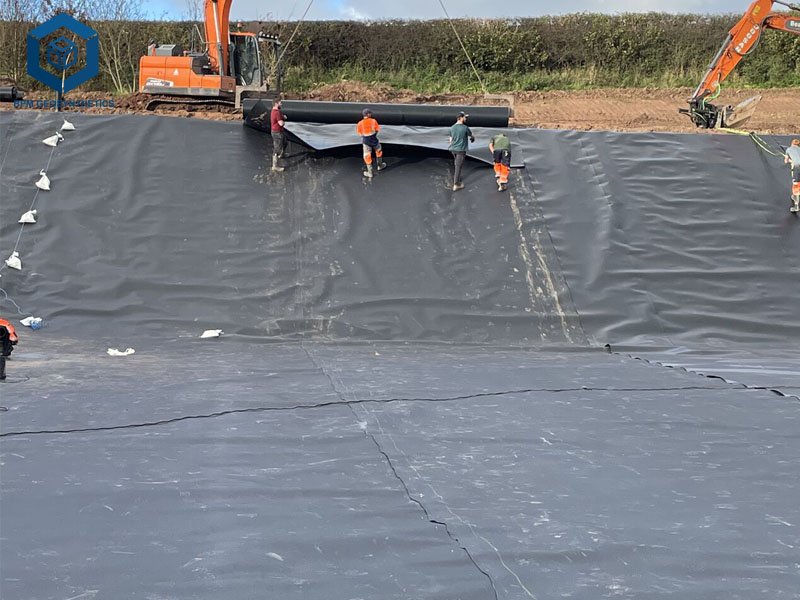
6. Additional Considerations for Geomembrane Professionals
6.1 Compatibility with Geosynthetics
Geotextiles add 20% puncture shield; drains boost 30% landfill flow.
6.2 Inspection and Upkeep
Annual D5887 tests sustain 95% efficacy; recoats for UV sites.
6.3 2025 Innovations
Bio-additives green 10%; AI welding cuts errors 25%.
7. Conclusion
Geo membranes anchor 2025’s sustainable infrastructure, with data-proven barriers like 45 kN/m tensile and <10⁻¹¹ cm/s permeability ensuring 100-year spans. From Solmax’s Ultra to BPM’s versatile HDPE, our 12 excel per GRI, with BPM as editor’s choice for 99.9% containment and customization.
Secure your projects: Review specs, ensure compliance, partner wisely. For BPM inquiries, visit BPM HDPE Liners. Containment excellence awaits.
Get Instant Quote: Specify BPM HDPE Liner? Submit at BPM Geosynthetics —24-hour OEM/ODM response.


